White, gold or dark rum: what the colour tells you, and what it doesn't
Clear means young and dark means old? Not in rum. Colour comes from time in wood, charcoal filtering, caramel and added sugar, and only the first has anything to do with age.
Drag the years, switch the climate and add a filter or caramel to see how the same rum changes colour, and why tropical casks lose far more to evaporation. Then learn what really tells rums apart.
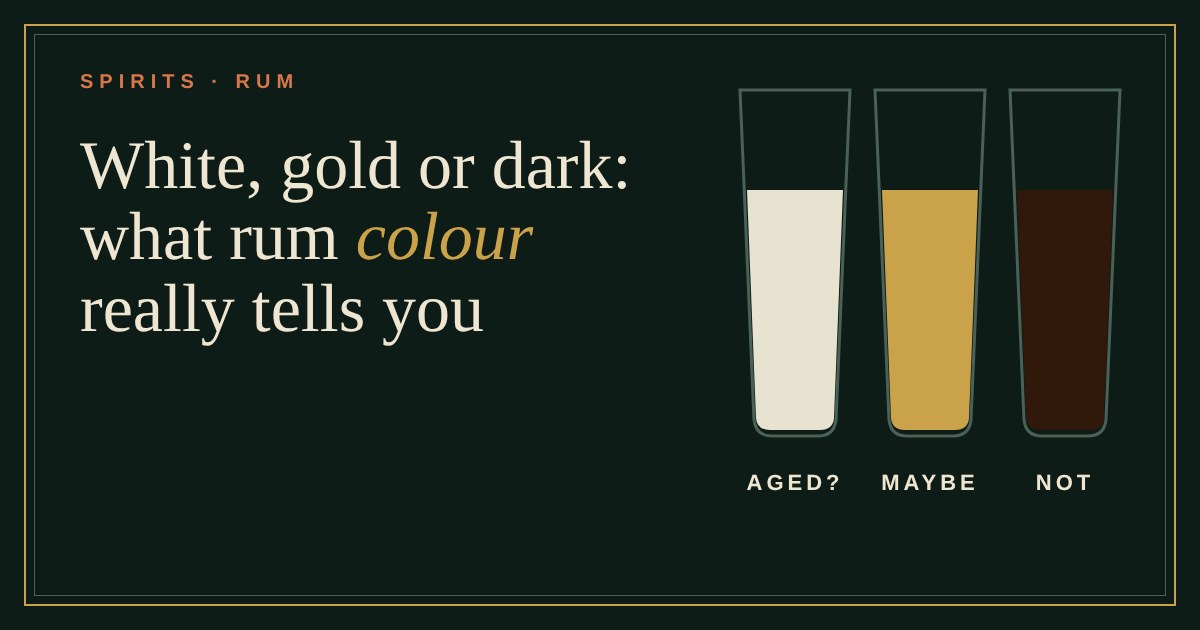
Pour three rums side by side and the colour seems to tell a story: clear is young and sharp, gold is middle-aged, dark is old and serious. It is a tidy story, and it is mostly wrong. Colour in rum is shaped by four separate things, and only one of them is age.
Four things that set the colour
Time in wood. Oak gives colour, but how much depends on the cask (first-fill barrels give more than tired ones) and on the climate it sits in. Filtering. Many white rums are aged first, then passed through charcoal, which strips almost all the colour. Some well-known light rums spend three years or more in oak and still come out clear. Caramel. Caramel colouring (E150a) is widely allowed and widely used, partly to make every batch look the same. Molasses and added sugar. The darkest, stickiest styles often owe more to these than to long ageing.
So a clear rum can be aged, and a near-black rum can be young. Colour on its own tells you very little.
Why the tropics change the maths
A cask is not airtight. Some of the liquid slips out through the wood every year; distillers call it the angels' share. In Scotland that is around 2% a year. In the Caribbean it can reach about 10%, because heat drives faster evaporation and faster contact with the wood. That is why a tropical rum can taste well aged at five years and why a twelve-year-old may have lost most of its cask. It also means ages are not comparable across countries: five years in Barbados and five years in Scotland are different experiences.
Where the real differences are
If colour will not tell you, what will? Start with what it was made from. Most rum is distilled from molasses, the thick by-product of sugar making. Rhum agricole, the French style, is made from fresh sugarcane juice instead, which tastes grassier and more vegetal. Martinique's agricole has had its own protected appellation (AOC) since 1996, with fixed rules on cane, distillation and labels. Brazil's cachaça is also made from fresh cane juice.
Then look at how it was distilled. Column stills give a lighter, cleaner spirit; pot stills keep more flavour. Jamaican rums, made with long fermentations, lean towards heavy, fruity, funky flavours. Light rums from Cuba and Puerto Rico are the other end of the scale.
Last, what was added after. Rules differ by country. Some places allow added sugar and caramel, others restrict both. A smooth, sweet, very dark bottle may owe it to a sugar addition rather than to ageing, which is one reason producers who do not add anything often say so on the label.
Colour is a clue to how the bottle was finished, not how it will taste.
What to look for on a label
An age statement, which in most places refers to the youngest rum in the blend. The country, because it sets the rules. The base ingredient: molasses or cane juice. A statement about additions, where the producer makes one. And the strength: 40% is common, but plenty of rums are bottled higher, so pour smaller.
A last note: higher strength and sweet flavours both make it easy to drink more than you planned. Rum is best sipped and shared slowly, and never before driving.