Milk first or milk last in tea? What the 75°C line really means
Milk first or milk last in tea? The argument rests on one number: milk proteins change shape above about 75°C. This piece explains where that figure comes from, who says what (a Loughborough chemist, the UK tea industry and the ISO tasting standard), and lets you pour a virtual cup both ways to see how the order changes what temperature the milk sits in.
It is a simplified model, not a verdict, and it also covers the brew time and water that matter far more than the order of the pour.
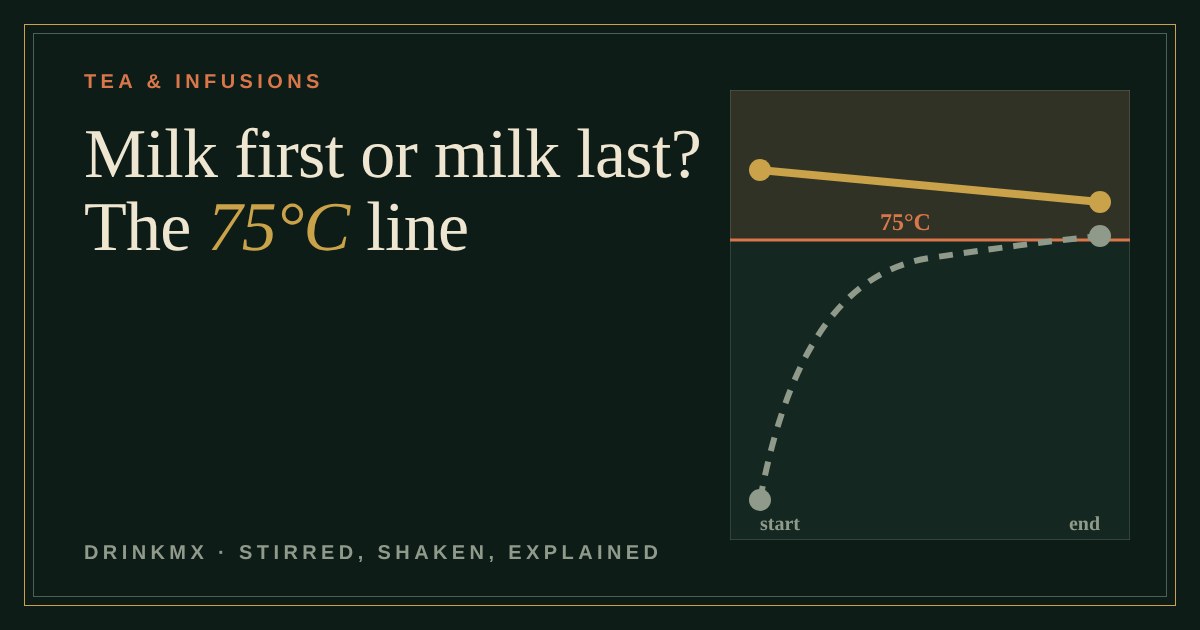
Pour the milk in first, or add it last? The argument is old, and it comes with a number attached: 75°C. Milk proteins start to change shape above roughly that temperature, so the story goes that milk poured into very hot tea gets "scalded", while milk that goes in first never meets liquid that hot. This piece lets you test that idea with your own cup, then explains what it does and doesn't tell you about taste.
Where the 75°C comes from
In 2003 Andrew Stapley, a researcher at Loughborough University, studied the chemistry of a cup of tea. His point, as reported by the Royal Society of Chemistry's education site, was that milk proteins denature (lose their shape) above 75°C. Pour a splash of cold milk into freshly brewed tea and each droplet first meets liquid close to boiling. Put the milk in first and the tea cools as it pours in, so the mixture is likely below 75°C before the two properly meet.
That is the heat argument. The other side has a different one: the UK Tea & Infusions Association advises adding milk after brewing, because milk in the cup too early gets in the way of the brew and waters the drink down. And the international standard for tasting tea, ISO 3103, puts the milk in the cup first when milk is used, and notes the liquid is at its best at about 65–80°C when milk goes in afterwards. So the two orders are both "official" in different settings. What follows is a way to see the temperature maths, not a ruling.
Pour it both ways
Set the size of your cup, how much milk you add, and the temperature of each. Then switch the order and watch the line. The chart follows the liquid the milk is sitting in as you pour, from the first drop to the last. Gold is the order you picked; the dashed line is the other one.
What the numbers say
Play with the sliders and a pattern shows up. Milk first starts with cold liquid and warms it step by step, so the milk spends less of the pour in very hot liquid. Milk last starts with the hottest liquid and cools it, so the first drops of milk meet tea at or near the temperature it poured at. The bigger the splash of milk and the cooler the tea, the smaller the difference.
Two things the model can't tell you. First, it doesn't say how much the shape change matters in the cup. Stapley's point was about the chemistry; whether people can taste the difference in a blind test is a separate question that this model can't answer. Second, it assumes the tea is poured straight from a hot pot. Let the tea cool for a minute in the cup and milk last stops looking so harsh, which is why the ISO standard talks about a 65–80°C window for adding milk afterwards.
If you only change one thing about your tea, make it the brew time, not the pour order.
Brew first, then argue
The pour order only matters if the tea underneath is good. For black tea, the UK Tea & Infusions Association suggests water at 90–98°C and 3–4 minutes of steeping, with one tea bag or a rounded teaspoon of loose leaf per cup. Its survey of more than a thousand people found most steep for only a minute or two, which gives a thin, pale cup that needs a lot of milk. Tasting panels work to a stricter standard: ISO 3103 uses 2 g of tea per 100 ml of freshly boiling water and a six-minute brew. Both agree on the same direction: give the tea time first, and it needs less rescuing.
- Use fresh water. Dissolved oxygen helps flavour, so don't reboil the same water repeatedly, and avoid very hard water, which can leave a scum on top of the tea.
- Time it. A phone timer beats guessing. Three to four minutes is the common recommendation for a cup, and longer for a strong mug.
- Take the bag or leaves out. Tea left in the cup keeps extracting and turns harsher the longer it sits.
- Add milk to taste. A splash (the ISO test uses just a few millilitres per cup) changes colour more than flavour. Taste, then add more.
Variations that skip the argument
- Warm the milk. If you steam or heat milk first, the 75°C question mostly disappears, because you chose its temperature yourself. Keep it below simmering.
- Use a plant milk. Oat, soya and other plant milks behave differently from cow's milk in hot tea, and some split in very hot or acidic drinks. Add them a little at a time and see.
- Go without. A good black tea at 3–4 minutes is often pleasant with no milk at all. A slice of lemon or a pinch of sugar changes things differently, so try them separately.
Black tea contains caffeine, though less than the same volume of brewed coffee. If you're sensitive to it, have your last cup earlier in the day or switch to a decaffeinated tea.
What to remember
The 75°C line comes from real chemistry, and the calculator shows how the order moves the milk across it. But the quality of the brew counts for far more than the order you pour in. Brew for the time on the pack, use fresh water, and pour in whichever order you like. If you ever want to check, the chart above takes ten seconds.