What makes a liqueur a liqueur? The sugar rule, and a sweetness and strength checker
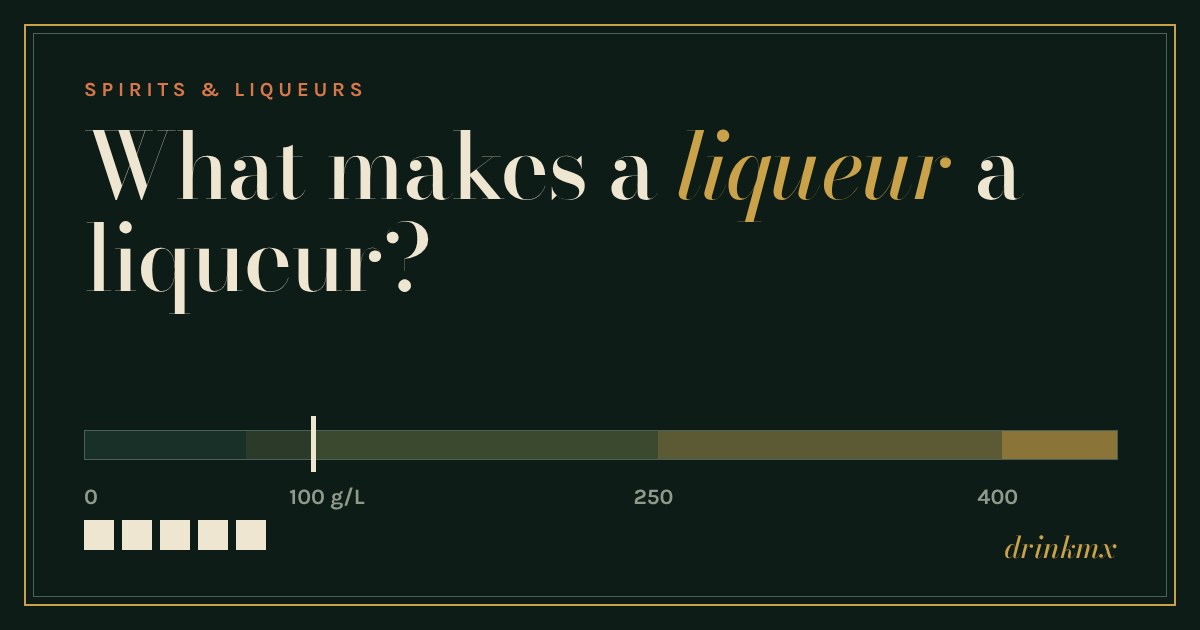
In the EU, liqueur is a legal word: at least 15% alcohol and at least 100 grams of sugar per litre, a little less sweet than regular cola.
Drag the sugar, strength and pour in the figure to see where a bottle lands, what it may be called (a gentian or cherry liqueur, a crème de, a cassis) and how many teaspoons of sugar and units of alcohol one pour carries. Plus why crème de has nothing to do with cream.
What the word liqueur actually means
On a shelf of bottles, "liqueur" looks like a style of flavour: orange, herbs, coffee, cherry. In the EU it is a legal word with two hard numbers behind it. A liqueur must be at least 15% alcohol, and it must contain at least 100 grams of sugar per litre. That is a little less sweet than a regular cola, and it is the line that separates a liqueur from a gin, a bitter or a flavoured spirit.
Drag the sugar and strength below to see where a bottle lands, what it may be called, and how much sugar and alcohol one pour carries. The gold buttons jump to the legal landmarks.
Why sugar is the dividing line
Sugar is not only sweetness. In a liqueur it carries the flavour, gives the drink its weight on the tongue, and softens the alcohol. A spirit like gin goes the other way. The botanicals are distilled into it, so the flavour arrives with almost no sugar at all, and the rules for London dry gin cap added sugar at 0.1 g per litre.
The two exceptions in the figure make sense once you taste the ingredients. Gentian is one of the most bitter roots there is, and cherry spirit already tastes of fruit, so both are allowed to be a little drier and still count as liqueurs.
How the flavour gets in
There are four common routes. Cold maceration steeps fruit, herbs or peel in alcohol and water for days or months, then drains and presses them. Infusion does the same with gentle warmth, around 30–50°C. Percolation pumps spirit again and again through a basket of dense botanicals such as roots, cinnamon or vanilla. Redistillation macerates first and then distils, which leaves the colour and tannins behind in the still. That last route is why clear orange liqueurs like triple sec are colourless.
Sugar is added at the end in every case, which is why you can often judge sweetness by how thick the liquid pours.
"Crème de" has nothing to do with cream. It is a sugar claim.
Crème de, cream and the amaro problem
A crème de menthe or crème de cassis is simply a very sweet liqueur. A cream liqueur is something else: a liqueur that also contains dairy cream and still has to meet the liqueur rules, so it is usually lower in strength, often around 15–20%.
Amari, the bittersweet Italian herbal drinks, are harder to pin down. There is no single definition, and they run from about 16% to 40% alcohol. Some sit in the liqueur zone, some are drier, so check the label rather than the word.
Using the numbers at home
The figure shows why swapping one liqueur for another can wreck a drink. Replace a 100 g/L orange liqueur with a 250 g/L crème and the same 20 ml pour carries two and a half times the sugar, so you may want to cut any syrup in the recipe. A good rule of thumb is to taste first and adjust by the teaspoon.
Strength matters too. A liqueur at 20% in a 25 ml pour is half a UK unit, which is gentler than a spirit but not nothing. Pour with a measure, and never drive after drinking.
A low or no version: an alcohol-free drink cannot be called a liqueur, but you can borrow the idea. Steep orange peel or herbs in cooled, strong tea, sweeten to taste with syrup and top with soda water. You get the same bittersweet shape with no alcohol at all.
Reading a label
Look for the word "liqueur" itself, which in the EU tells you the sugar and strength minimums were met. Look at the strength, since anything under 15% is not a liqueur. And look for a sweetness figure when the maker gives one, because two bottles with the same flavour can differ by a factor of two or more in sugar.