Pot still or column still? Why the shape of the still decides how much flavour survives, with a still bench
Cognac and vodka are both distilled, yet one tastes of fruit and oak and the other of almost nothing. A big reason is the still: a pot still runs a few rounds and keeps the raw material's flavour, while a column stacks many rounds in one tube and strips it away.
Drag the stages on a best-case still bench to see how strong the spirit gets, where cognac, bourbon and Scotch limits sit, and why the choice of still shapes character.
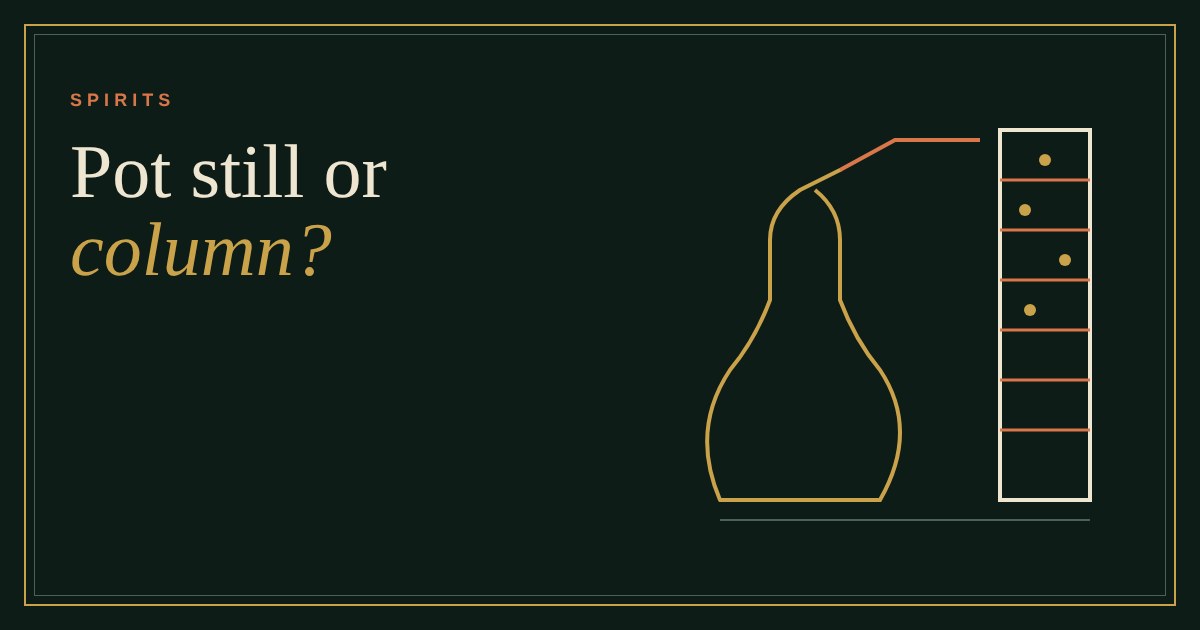
Pick up a bottle of cognac and a bottle of vodka and both say "distilled" on the label. Yet one smells of dried fruit and oak, and the other of almost nothing. A big part of that gap is the still: the copper pot or the tall column the liquid was boiled in. Same idea, different amounts of repetition.
The still bench
Below, a beer-strength liquid goes into a still. Each "stage" is one round of boiling and condensing, best case. Slide the stages up and watch the alcohol climb.
Why one boil isn't enough
Alcohol boils at about 78 °C and water at 100 °C. Heat a wash (the beer-like liquid that goes into the still, often 8–10% alcohol for grain, a little more or less for wine) and the vapour is richer in alcohol than the liquid it came from. In the chart, that is the copper curve sitting above the dashed diagonal.
Cool that vapour back to a liquid and you have a stronger liquid. Boil that and the vapour is stronger again. Each step up the staircase is one more round. That is the whole trick, and every still is a way of deciding how many rounds to run and how much else to carry along.
There is a ceiling. At roughly 96% alcohol, water and alcohol boil together and the vapour stops getting any richer. No ordinary still gets past it.
The pot still: few rounds, lots of character
A pot still is a copper pot with a neck. You fill it, heat it and collect what comes over. Then you empty it and start again, so it works in batches. One run gives a weak spirit (a "low wine"), so most pot-still spirits are run twice. A cognac eau-de-vie comes off at about 70%, and the law says cognac must be double-distilled in the traditional Charentais copper still, the shape of which is regulated too.
Because so little is removed along the way, plenty of the base's flavour comes with the alcohol: fruit, grain, oil, a bit of funk. The distiller shapes it by making cuts. The first part of a run (the heads) is sharp and solvent-like, the last part (the tails) is heavy and greasy, and the middle (the hearts) is what gets kept. Copper also helps pull out some sulphur smells, which is one reason it is the traditional metal.
By Scotch law, single malt must be made in a pot still, by batch distillation, from water and malted barley only.
The column still: many rounds in one tube
A column still is a tall tower holding a stack of plates. Vapour rises through them and, at each plate, some condenses and drips back down while the lighter, more alcoholic part keeps climbing. Each plate behaves like another little pot-still run, so a tall column does in one pass what would take a dozen runs in pots. It also runs continuously: wash goes in the top and spirit comes out all day, without stopping to empty a pot.
The column design that won out is Aeneas Coffey's two-column patent of 1830, though a continuous column had been patented in France as early as 1813. The trade-off is that more stripping means less flavour left over. That makes a column good for a clean, consistent spirit and for strength: vodka, grain whisky, and the neutral base that many gins start from.
Who uses which
| Spirit | Still |
|---|---|
| Single malt Scotch | Pot, by law |
| Cognac | Charentais pot, twice |
| Grain whisky, vodka | Column |
| Bourbon | Mostly column, then a pot-like "doubler" |
| Gin | Neutral spirit (often column), re-run with botanicals |
These are habits, not rules. Hybrid set-ups run a column first and a pot after, and some column-still whiskeys are rich and flavourful. Neither still is better; they answer different questions about how much of the raw material should be left in the glass.
What to take from this
If you see "pot still" on a label, expect a spirit made to taste of what it came from. If you see "column", expect clean and steady. A stronger vapour in the still is not a stronger drink in your glass: almost everything here is diluted to about 40% before bottling, so pour sensibly and measure.
Next time you taste cognac and vodka side by side (neat, in small measures, and not before driving), see how much of that gap you can put down to the number of rounds.