Blanco, reposado or añejo? What the age on a tequila label means, with a clock you can drag
Blanco, reposado, añejo and extra añejo are legal categories set by time in oak, not by colour. Drag a clock from zero to four years and see where each label starts, and why a gold swatch can still be a young tequila.
You will also learn what "100% agave" and "mixto" mean, why cristalino looks clear, and which style suits a Margarita, a Paloma or a slow sip.
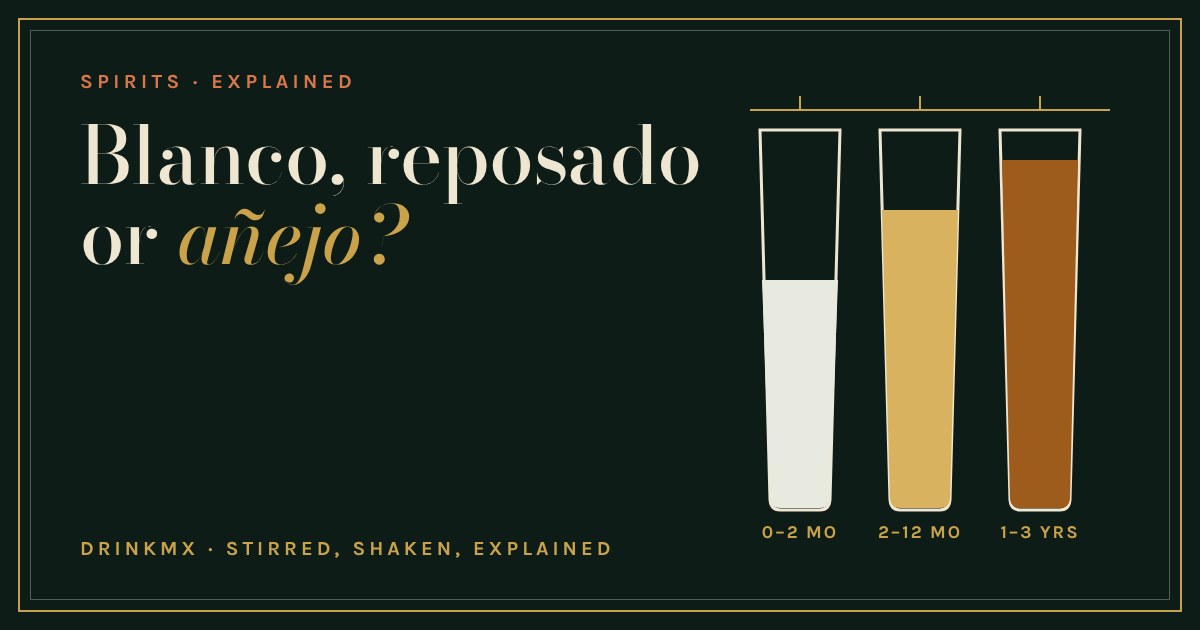
Walk into any bar and the tequila shelf is sorted by colour: clear bottles, pale straw ones, deep amber ones. The words on the labels, blanco, reposado, añejo, are not marketing. They are legal categories, and each one is defined by how long the spirit sat in oak. The catch is that colour and age are not the same thing, and the label is the part you can trust.
The four words, and the clock behind them
Tequila is a spirit distilled from the cooked sugars of blue Weber agave. After distilling it is either bottled straight away or rested in oak. The rules for the common categories, as set out by the Mexican standard that the Tequila Regulatory Council oversees, come down to time:
- Blanco (or plata): unaged, or rested in oak for less than two months. Clear, bright and peppery, with the raw agave front and centre.
- Reposado ("rested"): at least two months and under a year in oak. Pale gold, with a little vanilla and spice around the agave.
- Añejo ("aged"): at least one year and under three, in sealed oak barrels of no more than 600 litres. Amber, rounder and closer to a light whisky or brandy in feel.
- Extra añejo: three years or more, same barrel limit. A category added in 2006; darker, drier and woodier.
Two more words you will see. Joven or oro ("gold") is usually an unaged tequila that has been coloured or blended to look older. Cristalino is typically an aged tequila filtered with charcoal to strip the colour; it is not one of the official age categories.
Try it: turn the clock
Drag the slider to set how many months a tequila spends in oak, then switch the other two controls to see what the label may say. Watch the swatch: it can lie, the label cannot.
Why the colour misleads
Oak gives colour, but it is not the only way to get it. Some tequilas, especially gold mixtos, are coloured with caramel. Meanwhile a cristalino can come from an añejo and still look like water. So the rule is simple: read the word, not the shade. If you want to know what you are buying, look for "100% agave" and one of the four age words.
Barrels matter too, though not in the way people expect. Most producers use used American whiskey barrels, and a small cask hands over its flavour faster than a big one. A reposado from a 200-litre barrel can taste more oaky than one from a huge wooden tank, even at the same age.
Which one for which drink
There is no ranking here. They suit different jobs.
- Blanco for drinks where agave should shine through citrus and ice: a Margarita, a Paloma, a Tommy's. Its sharp edges are the point.
- Reposado is the all-rounder. It holds up in a Margarita, adds depth to a Paloma, and is gentle enough to sip.
- Añejo works in stirred drinks like a tequila Old Fashioned, where the wood plays a part and nothing fights it.
- Extra añejo is for sipping neat in a small glass, slowly. Mixing it with lime mostly hides what you paid for.
Most bottles sit around 40% alcohol by volume whatever the age, so an older tequila is not weaker or stronger, only different in flavour. Pace yourself and keep water nearby. If you would rather skip alcohol, a blanco Paloma works well with grapefruit soda, lime and a pinch of salt over ice, with no tequila at all.
What to look for on a label
The things that matter at any budget are few. Look for "100% agave" if you want the sugar to come only from agave. Look for one of the four age words rather than a colour. Treat "gold" with care, as it often means a coloured mixto. And note that a very pale reposado is normal, not a flaw.
Once you know that the word is the answer and the colour is only a hint, the shelf stops being a guessing game. You can pick a style for the drink in your hand, not the one in the best light.