Tea bag or loose leaf? How the size of the pieces sets the steep, with a leaf-size brew chart
Is loose leaf tea really better than a tea bag? The difference is less about the bag and more about the size of the pieces inside. Small pieces brew fast and turn harsh fast; whole leaf is slower and more forgiving.
Drag the steeping time and your target strength to see how whole leaf, broken leaf, fannings and dust compare, and how wide the comfort window is for each.
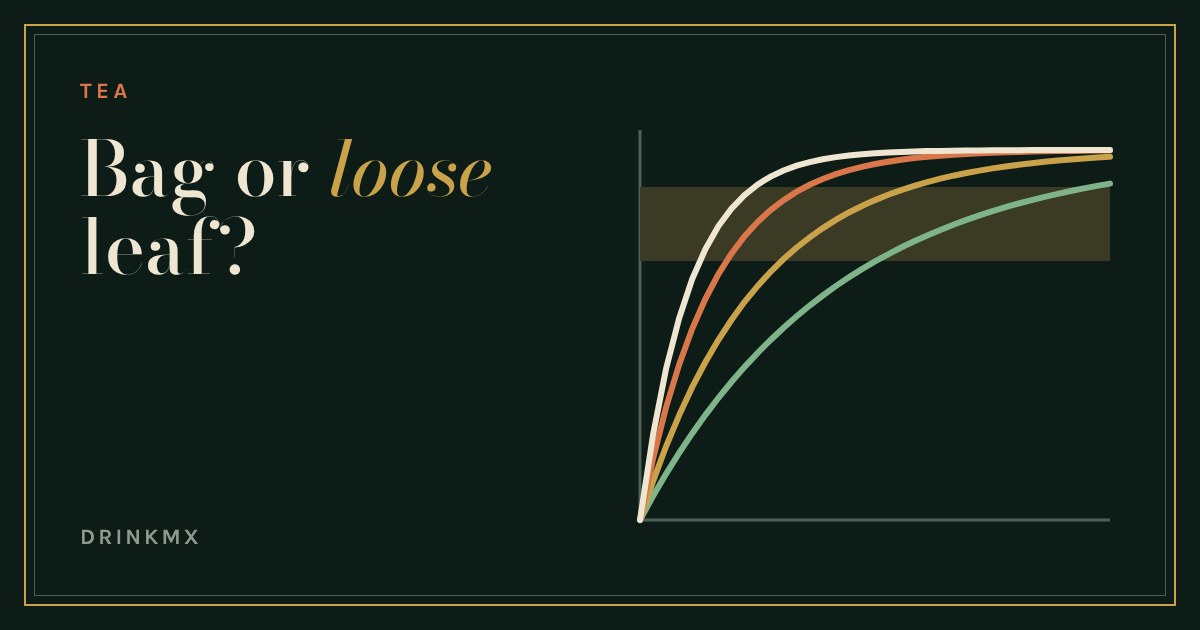
Loose leaf tea is better than tea bags. That is the usual line, and it is only half right. The real difference is not paper versus no paper. It is the size of the pieces in the cup, and size changes how fast a tea gives up its flavour, and how quickly it tips from good to harsh.
What is actually in the bag
When tea leaves are made, they are rolled, cut or crushed, then sorted by size. Tea people use four broad grades. Whole leaf is leaf that is still mostly intact. Broken leaf has been snapped into smaller pieces. Fannings are the small fragments left over from sorting, and dust is the finest of all, like coarse powder.
Most standard supermarket tea bags are filled with the smaller grades, mainly broken leaf, fannings and dust. That is not a scandal. Small pieces fit through the bag, they fill a mug with colour in a couple of minutes, and they make a strong, dark, reliable cup that takes milk well. Many people like exactly that. Some bags, especially the larger pyramid kind, do hold bigger pieces of leaf, so a bag is not always low grade. Check the pack.
Small pieces are not worse tea. They are faster tea.
Why small pieces brew faster
Hot water pulls flavour out of the leaf from the outside in. Cut a leaf into small pieces and far more of it touches the water at once, and the flavour has a much shorter trip to get out. So fannings and dust give you a dark cup in about a minute, while a whole rolled leaf needs a few minutes to unfurl and open up.
The catch is what happens next. Every tea has pleasant parts that come out early and bitter, drying parts (astringency, the mouth-puckering feeling) that keep coming if you leave it. A fast-brewing tea reaches the harsh end of the curve fast too. A bag left in the mug while you answer a message goes from rich to rough in no time. A big-leaf tea is slower, so it forgives you more.
Drag the time slider and watch the four dots. At two minutes the dust is already well past where the whole leaf is. Then raise your target strength and see how much longer the big leaf needs. The last column is the one that matters for real life: the comfort window is the gap between "ready" and "too strong". It is a few times wider for whole leaf than for dust.
The case for loose leaf (and its limits)
Room. Whole leaf unrolls as it soaks. In a tight paper bag it cannot, so the water reaches it unevenly. A pot, a basket infuser or a mug with a wide strainer gives it space. This is the main reason bigger-leaf teas are better loose or in a roomy bag.
More than one infusion. Whole and broken leaf keep giving flavour over several steeps, which is the point of gongfu-style brewing (see our piece on gongfu or western tea). Fannings and dust give most of what they have in the first steep.
Choice. A fine single-estate oolong or a delicate Japanese green simply does not come as dust. The loose-leaf shelf is where the interesting teas are, and the grade is part of why they cost more.
The limits are just as real. A strong builder's-style brew with milk is made to be quick and dark, and small pieces do that job well. Bags are also faster, tidier and easier to portion. Convenience is a fair reason to buy them.
A little history, kept short
The tea bag is commonly credited to a New York tea merchant, Thomas Sullivan, who around 1908 sent customers samples in small silk bags. Some people dropped the whole bag into the cup, and the idea took off, first as gauze and later as paper. Bags reached Britain in the 1950s, and today they make up the large majority of tea sold there.
What to look for
- Match time to size. The smaller the pieces, the shorter the steep. Follow the pack for bags, and taste early with loose small-cut tea.
- Give leaf room. Whole leaf wants space to open, so use a pot or a roomy infuser rather than a tiny ball.
- Remove the bag or leaf. Taking the bag out is the easiest fix for bitter tea.
- Use freshly boiled water for black tea, cooler for green. Leaf size does not change the temperature each tea likes.
- Pick on what you want. Fast and dark with milk? A good bag is fine. A tea you want to sip slowly and re-steep? Go loose.
Whichever you choose, tea has caffeine, so keep an eye on how much you have late in the day.