Why add water to whisky? What dilution does to a cask-strength dram, with a dilution glass
Why does a splash of water open up a strong whisky? A 2017 molecular simulation suggests the smoky compound guaiacol sits at the surface of the drink up to about 45% ABV, and moves into the body of the liquid near 59%. It is a computer model, not a tasting, so treat it as a hint.
Pick a cask-strength strength and a pour, then add water a teaspoon at a time in a dilution glass. See the new ABV, how much water it takes, and why the alcohol itself never goes down.
Pour a whisky bottled at cask strength and the first sniff can feel like a hot wire up the nose. Add a few drops of water and it opens up. Old advice says so, bartenders say so, and in 2017 two Swedish researchers tried to explain why. Here is what that study did and did not show, and how much water the maths says you are adding.
Cask strength is not bottle strength
Whisky comes out of the barrel well above the strength you usually buy it at. Most bottles are watered down to about 40–46% ABV (alcohol by volume) before they are sold. A bottle labelled cask strength (or barrel proof) has not been substantially diluted after maturing, and typically sits somewhere around 52–66% ABV. Forty percent is the usual legal minimum for something to be sold as whisky in most places, including the UK, the EU and the US.
So a cask-strength pour has roughly a third to two-thirds more alcohol in every sip than a standard 40% bottle. That is why it burns, and why numbing of the nose can hide the smells you came for.
What the study found
Karlsson and Friedman (Linnaeus University, Scientific Reports, 2017) ran molecular dynamics simulations: a computer model of individual molecules in water and ethanol mixtures. They followed guaiacol, a compound that gives whisky smoky, woody and spicy notes. They asked a simple question: at what strength does guaiacol sit at the surface of the liquid, where it can escape into the air and reach your nose?
- In pure water and in mixtures up to roughly 45% ethanol by volume, guaiacol preferred the surface.
- At 59%, it had moved toward the body of the liquid.
The authors suggest that diluting cask-strength whisky could bring more guaiacol to the surface.
Two honest caveats. This was a simulation of one compound, not a panel of people tasting. And whisky holds hundreds of aroma compounds, which do not all behave like guaiacol. Treat it as a good reason the old advice works, not as proof of an ideal strength.
Try the dilution yourself
Pick a starting strength and a pour, then add water a little at a time. The bar shows where you are against the two points from the study. The rule of thumb behind it: the amount of pure alcohol never changes, only the volume it is spread through.
A sensible way to use it
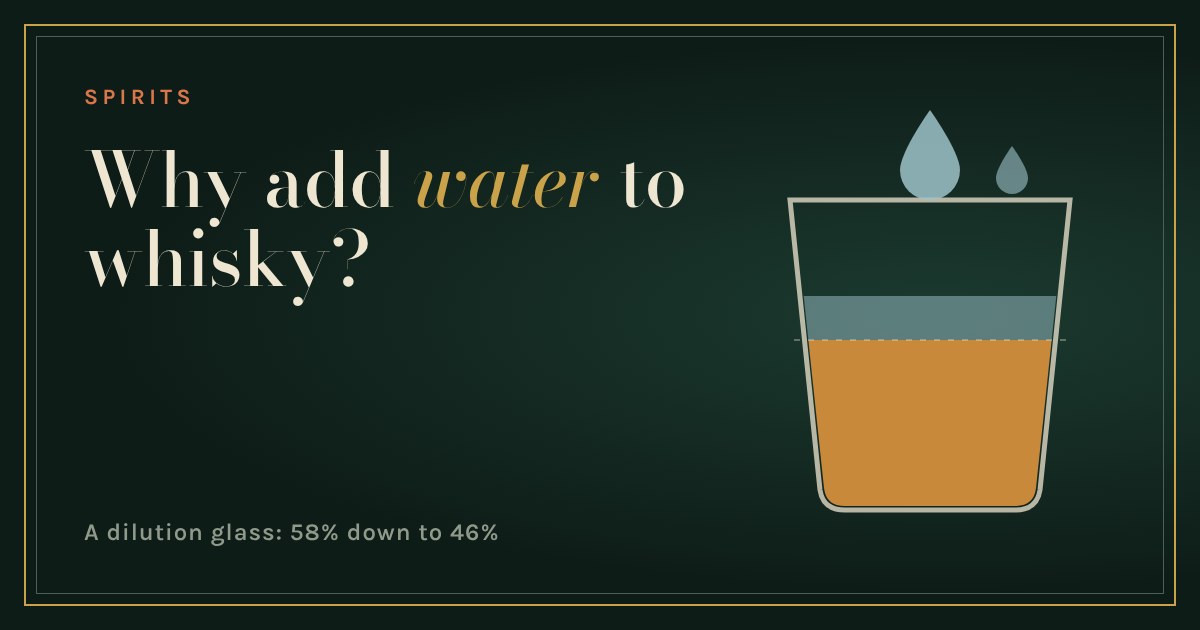
You do not need a calculator at the table, but the numbers explain the rule bartenders repeat: go slowly. For a 50 ml pour at 58%, taking it down to 46% takes about 13 ml of water, which is a lot more than "a splash". A teaspoon at a time lets you stop the moment it tastes right.
- Taste it neat first. Then add water, sniff, sip, repeat. Your own nose is the test, not the 45% line.
- Use a dropper or a teaspoon. Room-temperature still water is the simplest choice. Very cold water dulls aroma and flavour in general.
- Do not expect it to suit every dram. Some whiskies are already bottled where they taste best, and a few lose body when diluted. If it goes flat, you went too far.
- A haze is normal in some bottles. Whiskies that are not chill-filtered can turn slightly cloudy when water goes in. It does not mean the whisky has gone off.
What it does not do
Dilution changes the taste, not the amount of alcohol you are drinking. A 50 ml pour at 58% still holds about 29 ml of pure alcohol whether you sip it neat or with 13 ml of water, which is nearly three UK units. Cask-strength bottles are meant to be sipped slowly and in small measures. Drink responsibly, and not if you are driving.
What to remember
Whisky is bottled at 40–46% mostly so you can drink it straight; cask strength is typically 52–66%. A 2017 molecular simulation suggests the smoky compound guaiacol sits at the surface up to about 45% and moves into the body of the drink near 59%, which fits the old advice to add a little water to strong whisky. It is a computer model of one compound, not a tasting, so use it as a hint and let your nose decide.