Why is bar ice clear? Freeze it one way, with a clear-cube planner
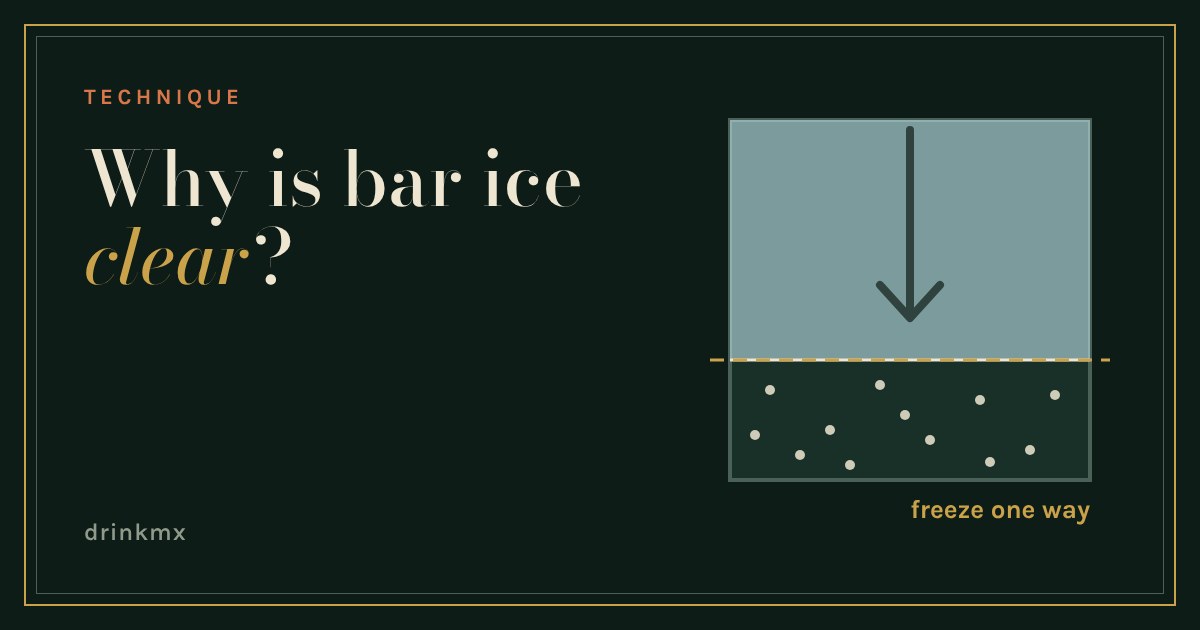
Tray ice goes white because air and minerals get pushed into the last water to freeze, and freeze in with it. Freeze the water in one direction and that air has somewhere to go.
Drag the freeze, compare an insulated box with an open tray, and work out how many clear cubes your box will give. A step-by-step cooler method, plus why boiling the water barely helps.
Why ice goes cloudy
Fill an ice tray with tap water and you get white, frosted cubes. The cloud is not dirt. It is thousands of tiny air bubbles and a little dissolved mineral that got trapped while the water froze.
A tray freezes from the outside in. Cold air hits the top and sides, so a shell of ice forms first and creeps towards the middle. As ice crystals grow they push dissolved air and minerals out of the way, into the water that is still liquid. In a tray there is nowhere for them to go. The last pocket of water in the middle collects everything, then freezes with it locked inside. That pocket is the white core you see.
Clear ice is not a different kind of water. It is water that froze in one direction, so the air had somewhere to go.
Freeze it in one direction
If the water freezes from the top down only, the front of ice moves steadily towards the bottom and shoves the air ahead of it. The top of the block comes out clear. The air ends up in the last layer to freeze, at the bottom, where you can cut it off and throw it away. Use the controls to see both ways of freezing, then plan how many cubes a block gives you.
The cooler method, step by step
You do not need a special machine. A small hard-sided cooler that fits in your freezer does the job, because its insulated walls and base stop the water freezing from the sides and bottom.
- Fill the cooler with clean, cold water, leaving about 2.5 cm (an inch) of space at the top. Leave the lid off so the top is the cold side.
- Put it in the freezer on a flat shelf and do not move it. Knocking it can disturb the front.
- Freeze for around a day for a small cooler. Check it: you want about two-thirds frozen, with liquid still underneath. If it freezes solid, you can still use it and cut the cloudy bottom away.
- Take it out, tip the cooler over a sink or tray, and let the unfrozen water drain. Let the slab sit for a few minutes to temper (warm slightly) so it does not shatter.
- Score a line about 1 cm deep with a serrated knife, then tap the back of the blade with a mallet to split the slab. Cut into cubes or long spears.
Always wear gloves or hold the slab in a towel, and cut on a stable board. Ice is slippery and the knife is sharp.
Does boiling the water help?
Not much. Boiling does drive out some dissolved air, but it dissolves back in as the water cools, and the freezing direction matters far more. Distilled or filtered water can give a slightly clearer result when your tap water is hard, but it is the one-way freeze that makes the difference. If your slab still has a faint haze, that is normal for tap water.
What clear ice does in the glass
It looks better, and that is most of the reason. Without trapped air and with fewer flaws, a big clear cube is also less likely to crack when the drink hits it. A large cube melts slowly because it has little surface for its volume, so your drink stays cold without going watery fast. That comes from the size rather than from the clarity. Clarity does not change the flavour.
Clear ice earns its place in drinks that are mostly spirit over a single large cube, such as an Old Fashioned or a Negroni. It is also lovely in a glass of sparkling water with a citrus slice. For a drink that is shaken hard, ordinary ice is fine, because it is going to break up anyway.
The same block works just as well in a tonic, an iced tea or a mocktail. If you are pouring something with alcohol, drink responsibly.