1:1 or 2:1? Simple syrup, rich syrup and how to swap between them
Recipes say "simple syrup" without saying which one: equal parts sugar and water, or twice as much sugar as water, called rich syrup. Swap one for the other without adjusting and your drink turns too sweet or too thin.
Build a batch at either ratio by weight, see how much sugar and water you need, and convert any recipe from 1:1 to 2:1 and back. Plus why rich syrup needs warmth, why weighing beats cups, and how to keep it fresh.
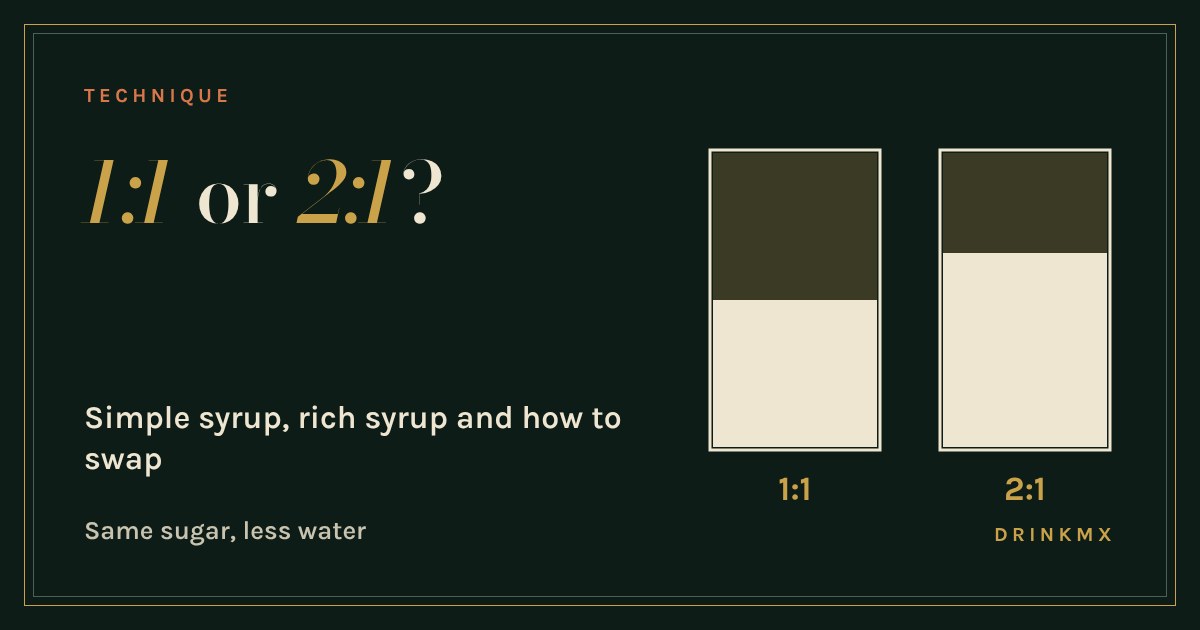
Almost every bar has a bottle of sugar syrup, and almost every recipe says "simple syrup" without saying which one. Some mean equal parts sugar and water. Others mean twice as much sugar as water, called "rich" syrup. Swap one for the other without adjusting and your drink comes out too sweet, or too thin.
Both are just sugar dissolved in water. The only question is how much sugar, and that changes how sweet the syrup is, how much it waters the drink down and how easily it is made. Use the builder below to see the numbers, then read on for the reasons.
What the ratio changes
A 1:1 syrup is half sugar by weight (50 degrees Brix, the unit for "percent sugar in a liquid"). A 2:1 syrup is about two-thirds sugar (roughly 65 to 67 Brix). It is thicker, glossier and heavier, so a spoonful of it carries more sugar than a spoonful of 1:1. Difford's Guide, which has measured both, puts 2:1 at around one and a third times as sweet by that measure. Per millilitre it holds closer to 1.4 times the sugar, which is why 10 ml of rich syrup does the job of roughly 14 ml of simple.
So you use less. Less liquid means less water in the glass. A shaken or stirred drink already picks up water from the ice (dilution, the water the drink needs to taste balanced). A rich syrup adds a little less on top, which makes small drinks like an Old Fashioned feel tighter and punchier. If you do want the water back, add it by the teaspoon instead of reaching for a different syrup.
Same sugar, different amount of water. That is the whole difference.
Why 2:1 is harder to make
At room temperature water can hold a little over twice its weight in sugar. A 2:1 syrup by weight sits right at that edge, so it dissolves slowly and can grow crystals in the bottle if it cools or loses a little water. Gentle heat solves it: warm the water, stir in the sugar until the liquid runs clear, and take it off the heat before it simmers. Boiling hard drives off water, which quietly changes your ratio and can start to colour it.
1:1 needs no heat at all. Put equal weights of sugar and room-temperature water in a clean jar, seal it and shake for a minute or two. That is why many home bars stay with 1:1, and why many professional bars buy rich syrup ready-made.
Weigh it if you can
Cups and spoons give a slightly weaker syrup than a scale, because sugar is lighter than water for the same volume and settles unevenly. Measured by volume, 1:1 comes out at about 48 Brix and 2:1 at about 65, a little under the weight-based numbers. That is fine for a drink at home. If you want the same syrup every time, weigh it. A kitchen scale does it in seconds, and the builder above gives you grams.
Which one to use
Use 1:1 for lemonade, iced tea, iced coffee and long drinks, where the extra water does no harm and the syrup is quick to make cold. Use 2:1 where space in the glass is tight: stirred drinks, small sours, and anything where you do not want the syrup to dilute the spirit or the coffee. Both work in non-alcoholic drinks too: sweeten a mocktail, an iced latte or a pitcher of lemonade the same way and adjust to taste.
Whatever you pick, taste before you serve. Fruit, tea and coffee all have their own sweetness and sourness, and a recipe's measure is a starting point, not a law.
Keeping it fresh
Store syrup in a clean, sealed bottle in the fridge. Rich syrup keeps longer than simple because there is less free water for anything to grow in, but neither lasts forever. If it turns cloudy, smells off or grows anything on top, throw it away and make a new batch. Making small batches more often is easier than guessing how old a bottle is.
What to remember
When a recipe says "simple syrup", it means 1:1 unless it says otherwise. Weigh sugar and water for a repeatable result. Make 1:1 cold and 2:1 warm. If you swap, use roughly two-thirds the amount going from 1:1 to 2:1 and about one and a half times going the other way. Then taste, and adjust. Drink responsibly, and enjoy the alcohol-free versions just as much.