Why brew hot coffee over ice? The 60/40 rule, with a flash-brew calculator
Pour hot coffee on ice and it tastes watery. Brew it over the ice with a plan, and you get a bright, sweet iced coffee in about five minutes.
The rule: roughly 40% of the water is ice, 60% goes hot through the coffee, and the finished drink sits around 1:15. Use the calculator to set your cup size, ice share and strength, and see the grams for coffee, hot water and ice.
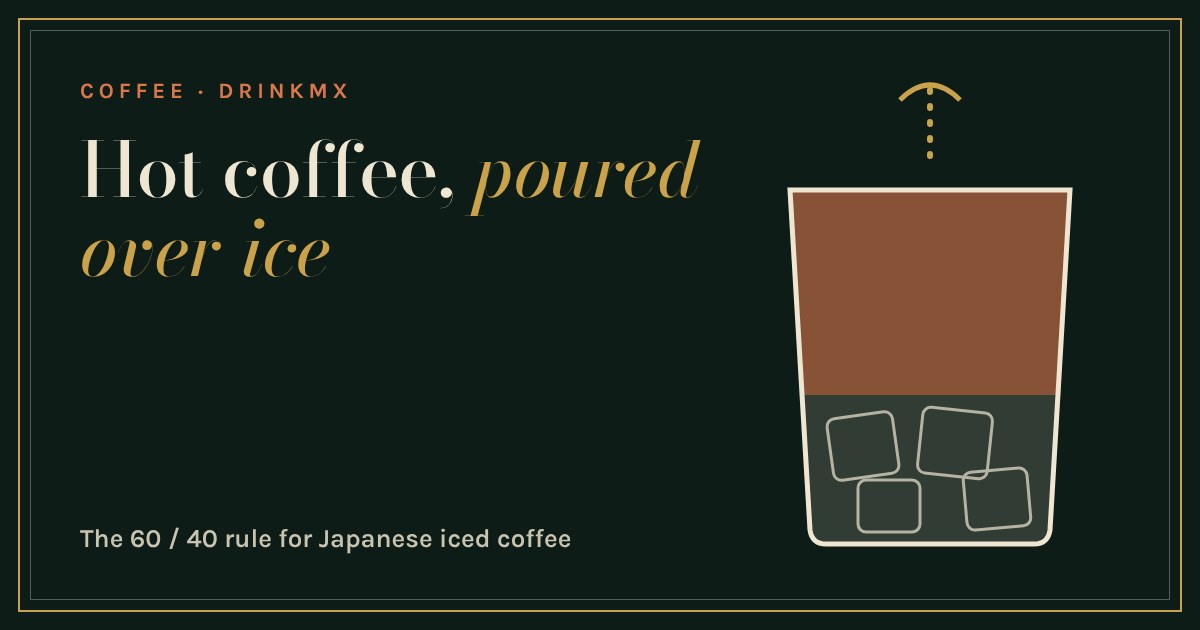
Pour hot coffee onto ice and you get a watery, flat drink. Brew on the ice, with the recipe changed to expect it, and you get something quite different: a bright, sweet, fragrant iced coffee in about five minutes. That is the idea behind flash brewing, often called Japanese iced coffee. The trick is not the ice. It is that you plan the melting before you brew.
Why you brew hot over ice
Cold brew gets its flavour from time: many hours in cold water. Hot water extracts much faster and pulls out more of the fruity, floral aromas, which is why a hot pour-over tastes livelier than most cold brew. Flash brewing keeps that hot extraction and then chills the coffee at once, so those aromas have less time to fade while the drink cools down on the counter.
The catch is dilution. Ice is water, and as it melts it makes the drink weaker. So you do not use all of your water to brew. Part of the water is held back as ice in the jug, and the rest is hot water that goes through the coffee. Because the hot part is smaller, the brew is stronger than normal, and the melted ice brings it back to a drinkable strength.
Hot water does the extracting. Ice does the diluting. Decide the split first.
The rule of thumb
Most flash-brew recipes land in the same place:
- Finished ratio: about 1 part coffee to 14–16 parts total water, counting the ice. A normal hot filter coffee is often around 1:16, but a flash brew is usually a touch stronger because the ice and the fast chill soften it.
- Ice share: about 40% of the total water as ice, with 35–45% as the usual range. The other 60% is hot water.
- Hot water: just off the boil, roughly 92–96 °C.
- Grind: a little finer than you would use for a normal pour-over, because less hot water has to pull out the same flavour.
For example, 30 g of coffee, 270 g of hot water and 180 g of ice make 450 g in total, a finished ratio of 1:15 with 40% ice. Recipes vary between roasters, so treat these numbers as a starting point, not a law.
The method, step by step
- Weigh the ice into the jug or carafe that sits under the dripper. Use ordinary ice cubes; very small crushed ice melts too quickly.
- Grind the coffee a little finer than for a regular pour-over, and put it in a filter in the dripper above the ice.
- Wet the grounds with about twice their weight in hot water and wait 30–45 seconds. This "bloom" lets trapped gas escape so the water can reach the coffee evenly.
- Pour the rest of the hot water in slow circles. The whole brew should take roughly three minutes.
- Swirl the jug until the last of the ice has melted, then pour over fresh ice if you like.
The same method works with an AeroPress or a drip machine with a removable pot, as long as the hot water ends up in a vessel that already holds the ice. A scale makes it easy; without one, use the same proportions by volume as a rough guide.
Why it works
Hot water pulls out sugars, acids and aromatic oils quickly. In a normal hot cup these keep changing as the coffee cools: the sweetness fades and bitter, drying notes come forward. Dropping the temperature in seconds, rather than minutes, holds the cup nearer to how it tasted at the end of the brew.
The strength rule works because ice is simply the "last pour" delivered frozen. If you want a 1:15 drink with 40% ice, you know exactly how much water has to come through the coffee: 60% of the total. That also means the grind has to do more of the work, which is why a slightly finer grind is the usual advice.
Flash brew or cold brew?
They answer different needs. Cold brew takes 12 to 24 hours, makes a big batch and tastes smooth, round and low in acidity. Flash brew takes minutes, makes one or two glasses at a time and tastes brighter and more aromatic. If you like fruity light roasts, flash brew shows them off. If you want a jug in the fridge for the week, cold brew is the practical one.
When to break the rule
- Dark roasts can turn harsh with a finer grind and very hot water. Keep the grind closer to normal, or the water nearer 92 °C.
- Tastes sour or thin: grind finer, or cut the ice share to 35%.
- Tastes bitter or heavy: grind a little coarser, or use a bit more ice.
- Making just one small cup: a very small batch needs a very fine grind to extract well, which can taste muddy. A bigger batch is easier to get right.
- Caffeine: a 450 g glass made with 30 g of coffee is a big, strong drink and can hold several cups' worth of caffeine. Share it, or use decaf, which works with this method too.
A quick note on safety: do not pour boiling water straight into a thin glass on top of ice without checking that the glass is heat-safe. Use a heat-resistant carafe or jug.
What to look for
Whatever you brew with, four things matter at any budget. First, a scale with 1 g steps, because the split between ice and hot water is the whole recipe. Second, freshly ground coffee from a grinder that gives an even size, since a finer grind magnifies any uneven particles. Third, hot water close to the boil, ideally poured in a slow, controlled stream. Fourth, a heat-safe jug that can hold the ice and the brewed coffee without cracking.