You pull a shot, take a sip, and your face tells you something is off. It is either sharp and thin, like biting a lemon peel, or dry and hollow, like over-stewed tea. Those two faults are the most common problems in home espresso, and they usually come from the same place: how much of the coffee ended up in your cup. The good news is that you can fix both with numbers you can measure and one control you can turn.
Sour and bitter are extraction problems
Hot water pulls things out of ground coffee in a rough order. Acids and light, fruity compounds come out first. Sugars and the rounder, sweeter flavours come next. The heavy, drying compounds that taste bitter and astringent come last. Extraction just means how far along that line your shot got.
Stop too early and you taste mostly the first group: the shot is sour, thin and one-dimensional. This is called under-extracted. Let the water run too long, or push too much of the coffee into the cup, and the last group takes over: the shot is bitter, dry and hollow. This is over-extracted. A balanced shot sits in between, where sweetness has had time to show up and the harsh end has not yet taken over.
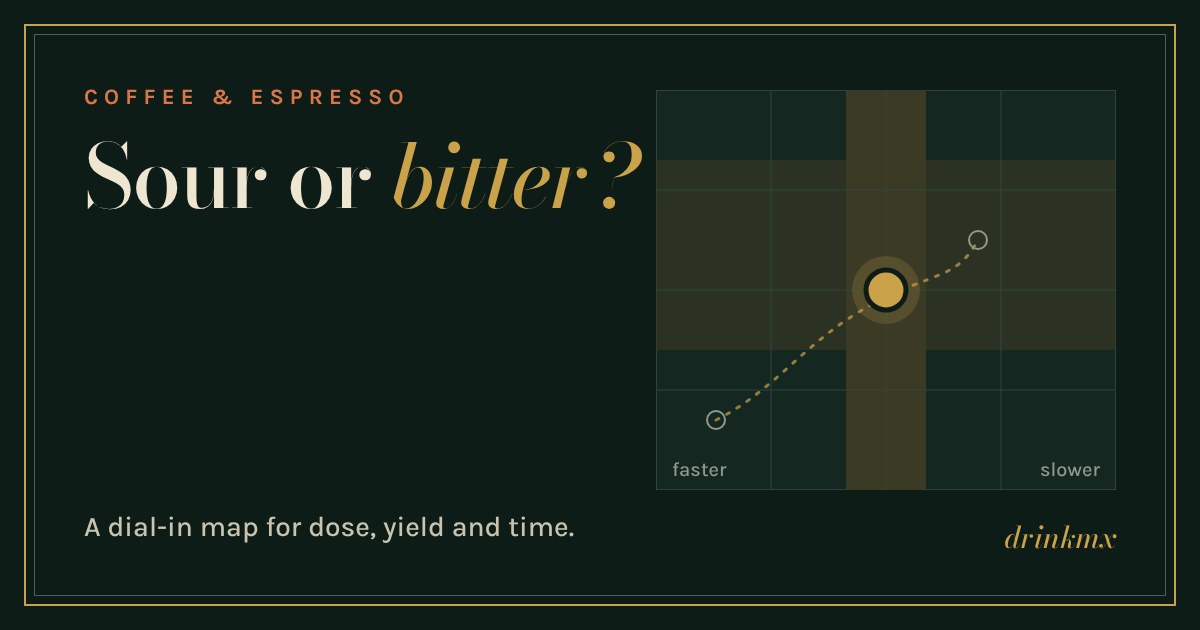
Under-extracted shots usually run fast, and over-extracted shots usually run slow. So time is a useful clue, but it is only a clue. The map below lets you see how three measurements fit together. Drag the dot, or move the sliders.
The three numbers to fix
Espresso is easier to repeat when you measure three things instead of guessing.
- Dose is the weight of dry, ground coffee in the basket. Weigh it to the tenth of a gram. A common double basket takes around 16 to 20 g, but your basket has a stated size, so use that.
- Yield is the weight of liquid in the cup when you stop. Put the cup on a scale and watch the numbers climb, because volume and crema make a cup look fuller than it is.
- Time is how long water takes from the moment you start the pump to the moment you stop.
Divide yield by dose and you get the brew ratio. A widely used starting point is 1:2, for example 18 g in and 36 g out, in about 25 to 30 seconds. Lighter roasts are often pushed to 1:2.5 or 1:3 to bring out sweetness and soften sharp acidity, while darker roasts are often kept shorter, around 1:1.5 to 1:1.8, to avoid harsh, ashy flavours. Recipes differ, and a roaster's own suggestion for their beans is a better starting point than any general number.
Taste is the verdict. Time and ratio just tell you where to look.
How to dial in, one change at a time
Dialling in means adjusting until the shot tastes good. Because the dose and yield are easy to hold still, the grind is the control you turn.
- Set your recipe. Pick a dose and a target yield, for instance 18 g in and 36 g out. Do not change these while you are adjusting the grind.
- Pull a shot and watch the clock. Stop at your target yield, and note the time.
- Taste a small sip. Sour and thin means you probably need more extraction. Bitter and dry means less.
- Change the grind by one step. A finer grind slows the water and extracts more, which helps a sour shot. A coarser grind speeds it up and extracts less, which helps a bitter one.
- Repeat. Change only one thing at a time, so you know what caused the difference. Stop when it tastes sweet and balanced, even if the clock says 24 or 33 seconds.
If a shot is already inside your time window but still tastes sharp, the ratio is the next thing to try. Letting the yield run a little longer, say from 1:2 to 1:2.3, extracts more without touching the grind. If it tastes bitter, a slightly shorter yield can help.
Why the clock is not the final word
Time is a symptom, not a target. Two shots can take 28 seconds and taste completely different. A few things can send a shot off course even when the numbers look right:
- Uneven flow. If water finds a crack in the coffee puck and rushes through it, some coffee is over-extracted and some is under-extracted at the same moment. The result tastes sour and bitter at once. Even tamping and a level, well-distributed bed help.
- Old beans. Coffee that is weeks past its roast date flows differently and tastes flat, whatever you do with the grinder.
- Different baskets and beans. A new bag or a new basket usually means a new setting. Expect to dial in again.
- Water. Very hard or very soft water changes extraction. If your machine has a temperature setting, hotter water extracts more and cooler water extracts less.
A note on caffeine while you practise: dialling in can mean a dozen shots in a sitting. Take a small sip of each rather than drinking them all. For most healthy adults, European food-safety guidance treats up to about 400 mg of caffeine a day as a safe amount, and a double espresso is often somewhere around 100 to 150 mg. Pregnant people are advised to keep to a lower daily limit, and anyone sensitive to caffeine, or with a heart condition, should ask a doctor.
What to look for in the kit
You do not need an expensive setup to dial in, but a few things matter at any budget:
- A scale that reads to 0.1 g. Whole-gram readings are too coarse for an 18 g dose and a 36 g yield. A timer helps, though your phone can also do that.
- A burr grinder that can go fine enough for espresso. Blade grinders chop unevenly, and some burr grinders are built for filter coffee and cannot grind fine enough for espresso.
- Small, repeatable grind steps. You want to change the grind a little and be able to return to the same setting tomorrow.
- A way to get the dose right. A grinder with a timer or a small dosing cup, or a scale to weigh the grounds, keeps the dose steady while you change the grind.
The picks below show a scale and two espresso-capable grinders at different price points. They are examples chosen to match this list, not reviews, and the links are affiliate links.