Most people spend their coffee money on the machine and the beans, then grind with whatever is closest. Yet the grinder decides something neither of those can fix: whether every piece of coffee gives up its flavour at the same speed. A grinder that makes pieces of wildly different sizes gives you a cup that is sour and bitter at the same time.
Why the size of the pieces matters
Hot water pulls flavour out of coffee from the outside in. Tiny pieces, often called fines (basically dust), give up everything fast and keep going into the harsh, bitter end. Big pieces, sometimes called boulders, are still only half-extracted when you stop, so they taste sour, thin and grassy. If your grind is a mix of both, the cup carries both faults, and no amount of fiddling with time or temperature balances them out.
That is the whole case for a good grinder: it does not make coffee taste better by magic, it makes the pieces more alike, so one brew time suits all of them.
Blade versus burr
A blade grinder works like a tiny blender. A spinning blade hits the beans at random and keeps chopping while the motor runs, so you get everything from dust to chunks, and the only control you have is how long you hold the button.
A burr grinder crushes beans between two toothed surfaces set a fixed gap apart. Beans can only leave once they are small enough to fit through the gap, so the pieces come out far more even, and you choose the size with a dial. Burrs come as flat pairs or as a conical cone-in-a-ring; both beat blades for evenness, and the choice between them is a finer point for later.
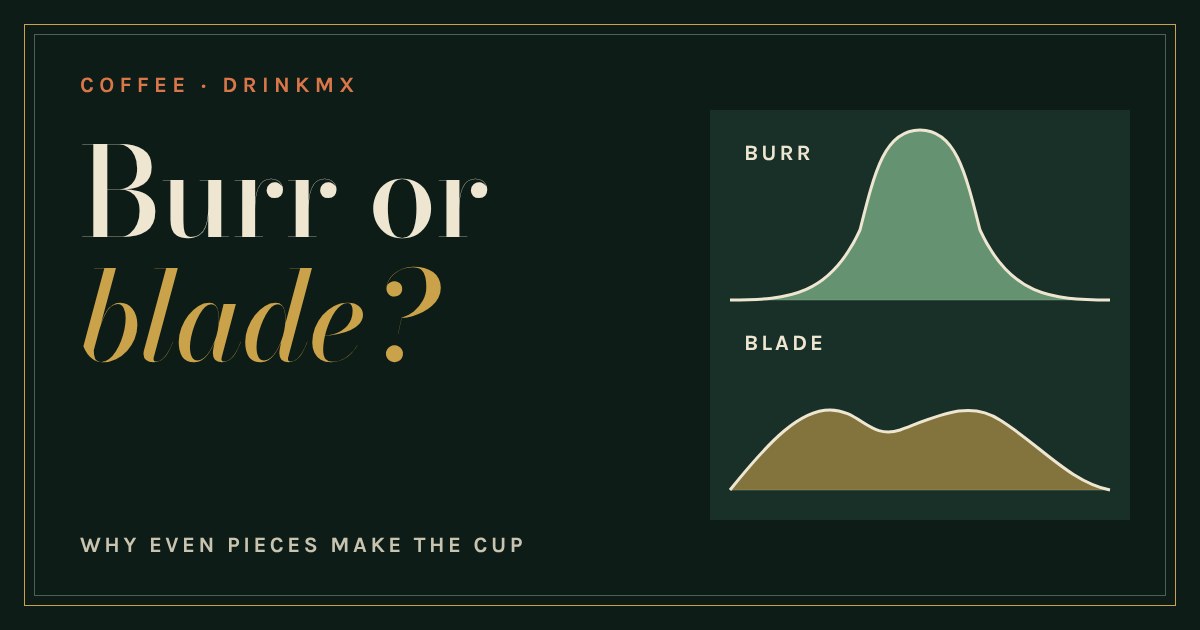
Try it. Switch between the two grinders with the setting in the middle and look at the shaded areas: the blade leaves a fat tail of dust on one side and chunks on the other, while the burr puts most of the coffee near the target. Then slide the setting. On the burr, the whole hump moves and stays tight. On the blade, the spread comes along for the ride.
What to do if you only have a blade
A blade grinder is much better than pre-ground coffee that went stale in a bag, so do not throw it out. Pulse in short bursts and shake the grinder between them so the chunks fall back to the blade. For a coarse brew like a French press or cold brew, the unevenness hurts least. For espresso it hurts most: espresso needs a fine, even grind that a blade cannot deliver.
Why a grinder beats a better machine
Espresso is the most demanding case: a small change in grind size can move a shot from sour to bitter, so the grinder needs a fine, repeatable dial. For filter coffee and French press you can get away with less, but the same rule holds: even pieces first, everything else second. If your budget is limited, a decent burr grinder with an ordinary brewer usually beats a fancy machine fed by a blade.
Grind just before brewing. Ground coffee loses aroma much faster than whole beans, so grinding at the last minute matters as well as the grinder itself.
What to look for
- Burrs, not blades. Flat or conical both work; steel or ceramic is fine at home.
- A stepped dial with enough steps. Filter needs a handful of settings, espresso needs many fine ones. Roughly 15 steps suit filter and press; 30 or more suit espresso.
- Size and cleaning. A hopper that matches how much you drink, and burrs you can reach to brush out stale grounds.
- Rough price bands. Blade grinders cost around €20–50, entry electric burr grinders around €50–100, and espresso-capable models start around €150–250. Pay for fine, repeatable adjustment only if you brew espresso.