No jigger? Measure cocktails with any cup: a ratio and grams tool
A jigger is just a measuring cup with a nice shape. What matters is using the same one for every ingredient, because most classic cocktails are ratios, not fixed millilitres.
Pick a drink and any vessel (spoon, shot glass, egg cup, espresso cup) and this tool counts the fills for each ingredient, with ml, US oz and grams for a kitchen scale. Plus the traps: shot glasses that lie, sticky honey, heaped spoons and the dash that is not a measure.
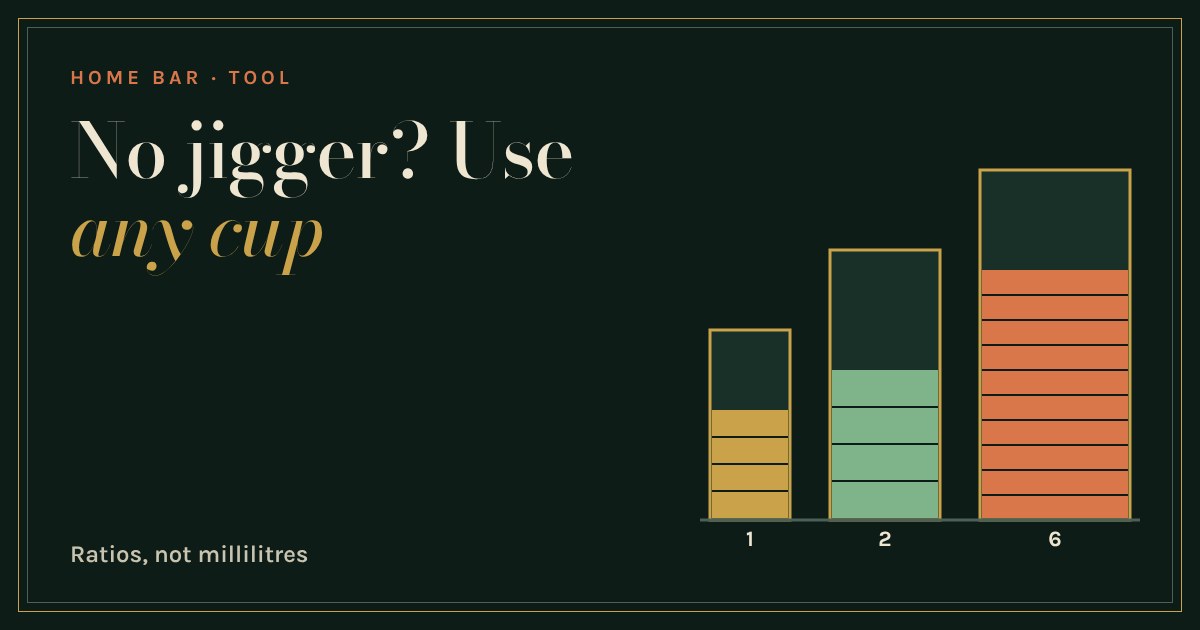
No jigger, no problem. A jigger is just a measuring cup with a nice shape, and the part of it that matters is not the 25 or 30 ml it holds. What matters is that you use the same one for every ingredient. Most classic cocktails are built from ratios, so any small vessel works as long as it stays constant through the whole drink.
Ratios beat millilitres
A Negroni is equal parts gin, sweet vermouth and Campari. A Daiquiri is commonly written as 6 parts rum to 2 parts lime juice to 1 part sugar syrup. A Margarita is often 2 parts tequila to 1 part orange liqueur to 1 part lime juice. None of those recipes says what a "part" is. A part can be a tablespoon, a shot glass, an egg cup or a quarter-cup, and the drink tastes the same, only bigger or smaller.
That is why a jigger is a convenience rather than a necessity. If your recipe is in millilitres, you can still convert it into parts: divide every number by the smallest one, round to the nearest whole number, and you have the ratio.
What to measure with
Kitchen measuring spoons are the easiest stand-in. A teaspoon is 5 ml and a bar spoon is designed to hold the same. A tablespoon is 15 ml in most metric countries; Australia uses 20 ml, so check the marking on yours. A US fluid ounce is about 29.6 ml, which most recipes round to 30 ml. The standard UK spirits measure is 25 ml, so a 25 ml pub-style measure from a kitchen drawer works for UK-style specs.
Shot glasses are a trap if you trust the label. They vary a lot, so fill yours with water from a measuring jug once and write the number on a piece of tape. After that it is a calibrated tool. Straight sides help, because you can judge half a measure by eye.
- Measuring spoons: good for small amounts such as syrup, bitters and liqueur. Level them off.
- A shot glass or small cup: good for the main spirit and juice, once you know its size.
- A kitchen scale: the most accurate of all. One millilitre of water or thin juice weighs about one gram, and the tool above converts the rest.
Why the scale works
Spirits at 40% alcohol weigh about 0.95 g per ml, a little lighter than water, because alcohol is lighter than water. Fresh citrus juice is close to 1 g per ml. Sugar syrup is heavier: a 1:1 syrup is about 48 °Brix and weighs roughly 1.23 g per ml, and a 2:1 rich syrup, at about 65 °Brix, is nearer 1.32. If you weigh a 1:1 syrup as though it were water you will pour a little less than the recipe asks for, which is a small error in a sweet ingredient, so in practice it is rarely worth worrying about. Use the gram column as a guide and taste the drink.
Small amounts and traps
- A dash is not a measure. It depends on the bottle. About 41 drops make a millilitre and 12 drops a dash, but a bottle with a wide neck pours far more. Add bitters a dash at a time and taste.
- Sticky ingredients lie. Honey and thick syrup cling to the spoon, so the next measure is off. Rinse the spoon, or thin the honey with a little warm water first.
- Heaped is not level. A heaped spoon of sugar can double the amount. Level it off with a knife.
- Don't change vessels mid-drink. Using a tablespoon for one ingredient and a shot glass for another breaks the ratio, which is the thing you were trying to protect.
A low or no version
The same trick works without alcohol. The tool above includes an alcohol-free sour built from soda water, lemon juice and a 1:1 syrup. Treat the ratio as a starting point: taste, then add a little lemon if it is too sweet or a little syrup if it is too sharp. Whatever you drink, pour sensibly and keep an eye on how much you make.
What to look for
If you do decide to buy a measure later, a few things matter more than the shape or finish:
- Clear markings in ml and oz, so you can follow any recipe without converting.
- A size that matches your drinks, such as 25/50 ml or 30/60 ml, so you rarely need to fill it twice.
- Straight, easy-to-read sides, so a half measure is easy to judge.