Why a Negroni is equal parts: the spec and a ratio builder
The Negroni is the simplest spec in the book: equal parts gin, Campari and sweet vermouth, built over ice. It looks like a guess, but it is a balance, because each bottle fixes a flaw in another.
Slide the three parts in the builder to see the glass, each bottle's share and a rough strength, then add or cut dilution with the stir. It also covers the popular origin story, how to fix a Negroni that tastes off, and lighter and alcohol-free versions.
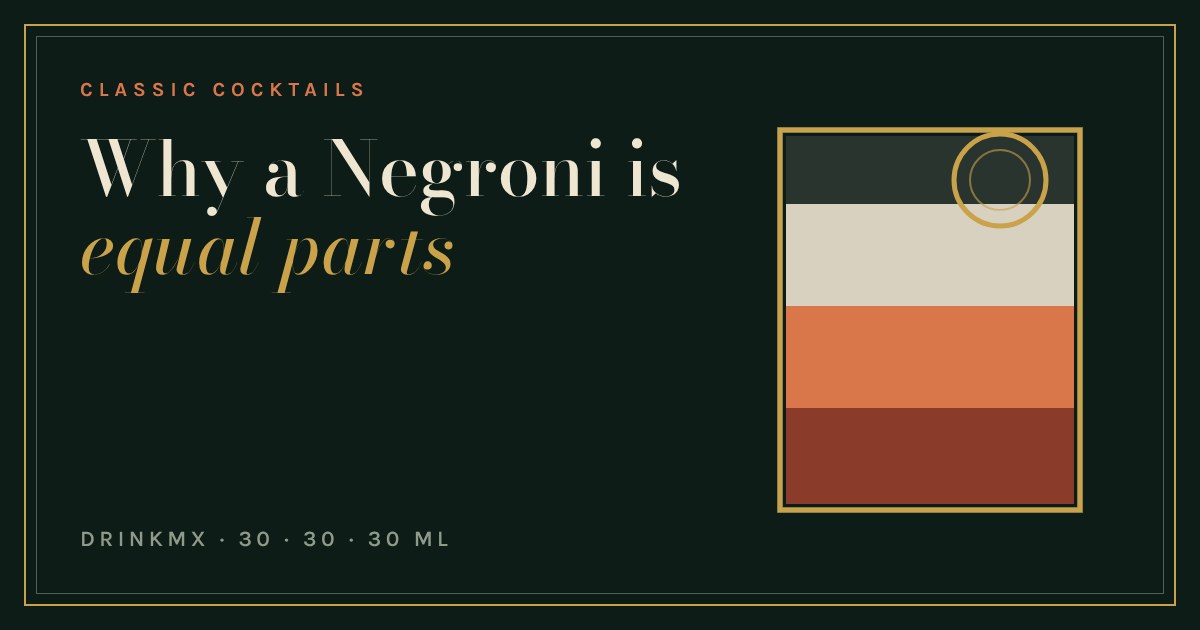
The Negroni has the easiest spec in the book: equal parts of three bottles, built in the glass over ice. It is also one of the most misjudged drinks, because "equal parts" sounds like a guess when it is really a balance. Bitter, sweet and strong each get a third, and none of them can win.
The spec
Method: fill a rocks glass with ice, ideally one or two large cubes. Pour in all three, stir gently for about 15 seconds so the drink chills and picks up a little water, and garnish. Many bars stir it in a mixing glass first and strain over fresh ice; that is also fine, and it keeps the drink from over-diluting. Glass: a rocks (old fashioned) glass. Garnish: a slice or a wide peel of orange; squeeze the peel over the top first so the oils land on the surface.
A line of history
The story most often told is that the drink was first mixed in Florence in 1919, at a café on Via de' Tornabuoni. A regular, Count Camillo Negroni, asked the bartender, Fosco Scarselli, to strengthen his Americano (Campari, sweet vermouth and soda) by swapping the soda for gin. Not every detail of that account is firmly documented, and other origin theories exist, so treat it as the popular version rather than settled fact.
Why equal parts works
Each ingredient fixes a problem in another. Campari is bitter and fairly sweet; on its own it is a lot. Sweet vermouth is round and herbal but soft, and it adds sweetness that tames the bitterness. Gin is dry and about 40% alcohol or more, so it adds backbone and a juniper edge that stops the other two turning syrupy. Take any one out and the drink falls over: without gin it is a heavy, sweet aperitif; without vermouth it is harsh; without Campari it is a weak Martini.
Equal parts is not a guess. It is the point where no single bottle is in charge.
The other thing a Negroni needs is dilution. Stirring over ice melts a little of it into the glass, which lowers the strength, softens the bitterness and lets the botanicals open up. A drink poured over small, wet ice and left to sit goes watery; a drink over one large cube stays cold with less melt. That is why the stir is short and the ice is big.
Bend the ratio
Use the builder to see what changes when you tilt the parts. It shows the glass, each ingredient's share, and a rough strength. The strength figure is an estimate: it assumes gin at 42%, Campari at 25% and vermouth at 16%. Campari's strength varies by market, so check your bottles and treat the number as a guide.
Fixing a Negroni that tastes off
- Too bitter: use a little more vermouth, or a fresher, better vermouth. Open vermouth is wine; once opened it oxidises, so keep it in the fridge and use it within a month or two.
- Too sweet or heavy: add a bit more gin, or a stronger, more juniper-forward gin. A London dry style cuts through best.
- Watery: use bigger, colder ice and stir less. The drink should end up cold, not weak.
- Flat: express the orange peel over the glass. The citrus oil on the surface is the first thing you smell.
Variations, including a lighter one
The Boulevardier swaps gin for bourbon or rye and is usually made with a bit more whiskey than the other two, which gives a warmer, rounder drink. The Negroni Sbagliato ("mistaken" in Italian) replaces the gin with sparkling wine, which makes it lighter and fizzy. For something with no alcohol, build the same shape from an alcohol-free bitter aperitif, an alcohol-free spirit with a juniper note and a splash of non-alcoholic vermouth-style drink over ice with an orange slice. Alcohol-free bitters vary a lot, so taste and adjust the shares with the sliders above.
A Negroni is a strong drink, three 30 ml measures of spirit, liqueur and fortified wine in one glass, with the bitterness hiding the strength. Treat it as a slow one: one is a good evening's drink, and the pure-alcohol figure above is there so you can see what is in the glass.