How to batch cocktails for a party: a calculator for volumes and water
Batching a cocktail means mixing a big jug ahead of time so you can enjoy your own party. It works if you do two things: scale every ingredient by the same factor, and add water, because the dilution a shaker or mixing glass gives you has to be added by hand.
Pick a drink, set your guests and how many each, and the calculator gives you the millilitres for the whole batch, plus a matching alcohol-free jug.
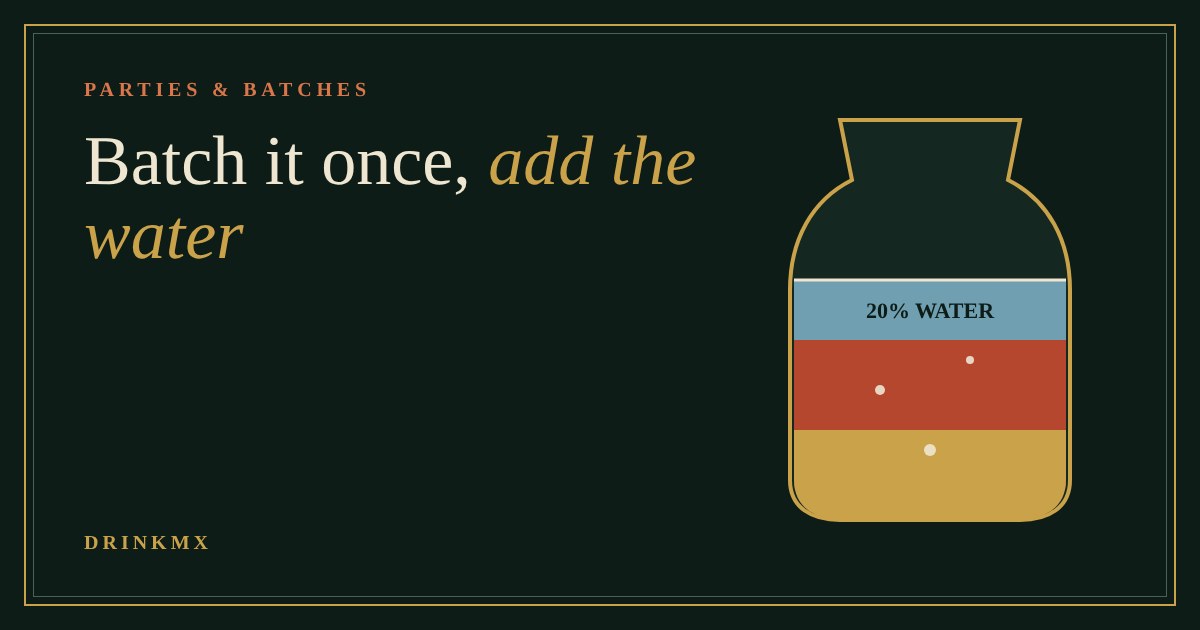
A good party drink is made once, in advance, so you can talk to your guests instead of standing behind a shaker. Batching means mixing a big container of one cocktail ahead of time, chilling it, and pouring each glass in seconds. It works well, but only if you do two things people often forget: add water, and scale every ingredient by the same factor. The calculator below does both.
Why you add water
When you stir or shake a drink with ice, some of the ice melts into it. That water is not a flaw: it takes the edge off the alcohol, opens up the flavour, and makes the drink easier to sip. A shaken or stirred cocktail typically ends up around 20–25% water. A Negroni mixed with no water and no ice tastes noticeably hotter and harsher than one that has been stirred.
In a batch there is no shaker doing that for you, so you add the water yourself, before chilling. A common rule is 17–25% of the final drink, which for a 90 ml Negroni means roughly 20 ml of water. The calculator turns your percentage into millilitres for the whole batch. If you will pour over ice, go lower, around 15%, because the ice in the glass will keep diluting the drink as people sip.
The rule of scaling
Every ingredient gets multiplied by the same number: servings × the single-serve measure. A Negroni for 24 servings is 24 × 30 ml of gin, 24 × 30 ml of Campari and 24 × 30 ml of vermouth. That keeps the balance exactly where the original recipe put it. If the original was good in a glass, it is good in a jug.
Scale the recipe, never the ratio. Then add the water.
Which drinks batch well
Drinks made only of spirits, vermouth and bitter liqueurs, like the Negroni, keep well for several days in a fridge or freezer, since they have no fresh juice to spoil. Anything with fresh citrus, like a Daiquiri or Margarita, tastes best the day you make it, since lime juice loses its brightness within hours. The usual advice is to juice the limes the same day, mix and chill the batch, and keep it in the fridge. Never batch fizz: add sparkling water, soda or sparkling wine to each glass when you serve it.
Stirred, spirit-only drinks can be chilled very cold and poured straight into a glass. Citrus drinks go in the fridge and are poured over fresh ice. Give the batch a good stir or shake of the container before serving, because ingredients can settle.
Make room for the alcohol-free guests
Some people don't drink at all, and some are driving. Rather than offering plain water as their only option, put a second jug on the table with something just as considered. The slider above splits your servings between the drink you picked and an iced tea lemonade, a simple cold black tea with lemon and sugar syrup that needs no added water because the tea is already the diluent. Label both jugs clearly, so nobody picks up the wrong one by mistake.
Pour for the guests, not the clock
The default of two drinks per guest is a planning figure for a few hours of party, not a target to push. Put out water and food, pour modest servings, and let people stop whenever they like. Counting on guests to drink more than they want is how batches get wasted, and worse. Nobody should be driving after drinking, so have non-alcoholic drinks, a lift home or a spare bed ready.
What to look for
You don't need special equipment. Look for a container with a tight lid that fits your fridge, such as a large jug, a clean bottle or a food-safe tub; a measuring jug marked in ml so the maths is easy to follow; a funnel for bottling; and a long spoon for stirring. Mark the container with the date and what is inside, and keep citrus batches cold until the moment you pour.