A big pot of coffee, tea or spiced punch is easy to make and surprisingly hard to keep at the right temperature. Guests arrive at different times, the pot sits, and an hour later you are serving something lukewarm. How fast a drink cools depends on three things you can control: the container, the volume, and whether the lid is on. This piece gives you a clock for it.
Cooling is exponential
A hot drink loses heat faster when it is much hotter than the room, and slower as it approaches room temperature. Physicists call this Newton's law of cooling: the gap between drink and room shrinks by the same fraction in each equal time step. So a drink drops quickly in the first half hour, then crawls. A mug of coffee goes from scalding to sippable in minutes, then takes a long time to go truly cold.
Two things set the speed. The first is the container: an open pot loses heat from the surface and by evaporation, a lidded steel jug loses it through the walls, and a vacuum flask has an air gap that blocks most conduction. The second is volume: a bigger batch has more heat stored for each square centimetre of wall, so it cools more slowly. As a rough rule for a similar shape, the cooling time grows with the cube root of the volume, so eight times the drink lasts about twice as long.
What the chart is telling you
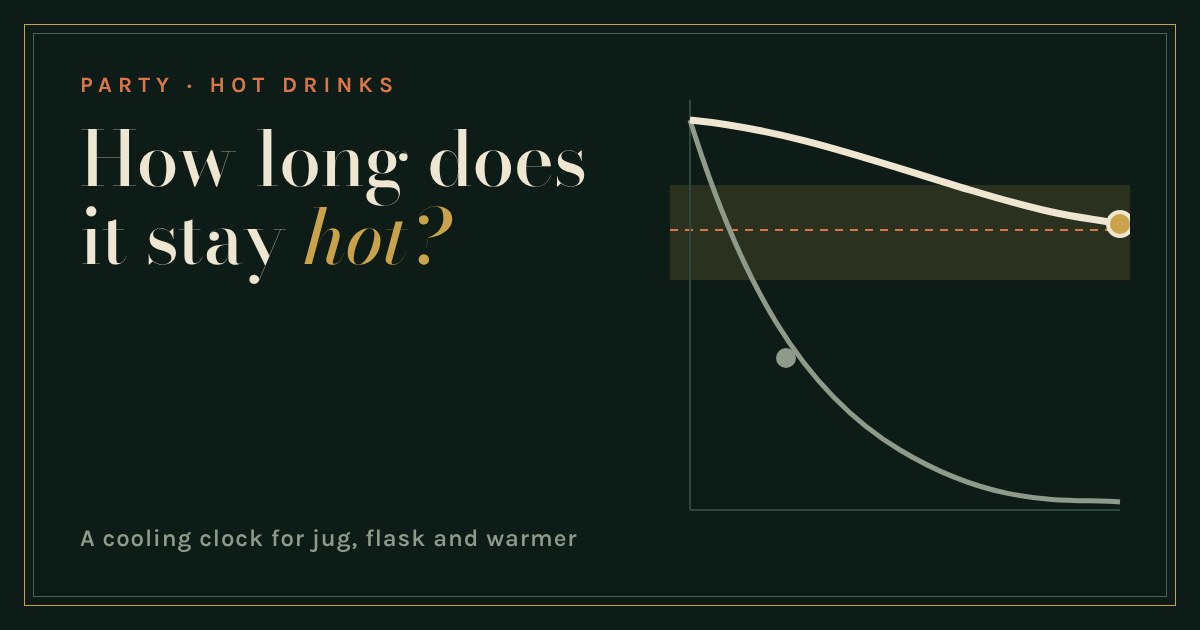
Try the three containers with the same 2 litres at 90 °C. In an open pot the drink is below 55 °C in well under an hour. In a lidded steel jug it stays in the serving range for around an hour or two. In a good vacuum flask it is still hot many hours later. Independent flask tests agree on the order of magnitude: in one consumer trial, every flask kept drinks above 50 °C for at least six hours in a cold room, and half lasted a full day.
Serving temperature has a ceiling as well as a floor. Studies of coffee drinkers put the preferred drinking temperature at roughly 55 to 70 °C, and a burn-risk model found a good compromise near 58 °C. Liquid near 80 °C scalds quickly if it spills. So a drink poured straight from a freshly boiled pot is too hot for guests, and the shaded band on the chart is where you want to serve.
Keep it hot enough to be pleasant and cool enough to be safe: the serving range is a window, not a floor.
A note on food safety
The 63 °C line on the chart is the usual UK rule for hot-holding food: hot food is kept at 63 °C or above, with a limited exception where it may be out for up to two hours once. A black coffee or tea is not a food-safety problem in the same way, but milky drinks, soups and anything with eggs or cream are best treated as food. If your batch has milk in it, keep it above 63 °C or serve it within two hours, and put anything left over in the fridge rather than back in the flask. Rules differ by country, so check the one where you are.
How to keep a batch hot, the practical rules
Preheat the container: fill a flask or jug with boiling water for five minutes, tip it out, then pour in the drink. A cold steel flask can take 10 °C off a hot drink in the first minutes. Fill it to the top, because air space is a place for heat to go. Keep the lid on and open it only to serve. Do not leave brewed coffee on a hot plate for hours: it keeps hot but most coffee guides agree it cooks the flavour and turns it bitter, while a flask holds the same heat without extra cooking.
For a punch or a pot of tea, a pot kept on a very low heat or a slow cooker on its warm setting keeps the drink at one temperature instead of letting it drift down. Hold it below a simmer, stir now and then, and check with a thermometer. Alcohol-free versions are the safest default for a crowd; if you do add alcohol, keep it as a cup-by-cup serving rather than something people top up all evening, and have water out too.
Caffeine adds up over a long party. A large batch of strong coffee served at the end of the evening is a lot of caffeine for people who then drive or try to sleep, so offer decaf or herbal tea next to it.
What to look for
Three things matter at any budget. A vacuum (double-wall) body is far better than a single wall that only looks like steel. A tight, full-width lid or a pump top that opens only when it is used keeps the heat in. And size: pick a flask or pot sized for the batch, since a half-empty vessel cools faster. Check the capacity in litres and whether the lid can be cleaned thoroughly, because milk and tea residue build up in the gap.