How far ahead can you make party drinks? A make-ahead clock for juice, syrup, cream and bubbles
You can make most of a party drink days ahead, but not all of it. Spirits, vermouth and syrup are steady; fresh citrus, cream, bubbles, ice and cut herbs are not.
A make-ahead clock shows what each ingredient does when you mix it hours or days early, for stirred drinks, sours, creamy drinks, spritzes and alcohol-free punch. Rules of thumb, a prep order, and an alcohol-free jug by default.
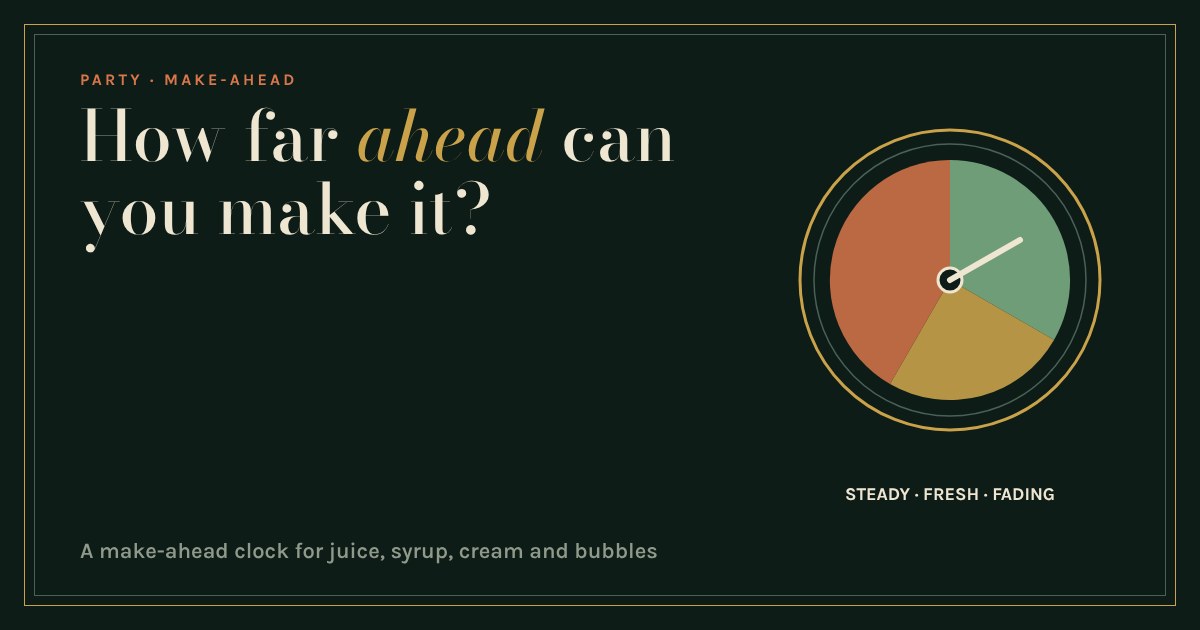
Batch the steady parts, hold back the fragile ones
Everyone wants to be out of the kitchen when the first guest rings the bell. The trick is not to make the whole drink early. It is to sort the ingredients into two piles: the ones that sit happily for days, and the ones that fade within hours. Spirits, vermouth, syrup and bitters are steady. Fresh citrus, cream, bubbles, ice and cut herbs are not.
Sources differ on exact numbers, so treat the times below as rules of thumb, not laws. They follow common bar guidance, such as VinePair's batched-cocktail storage guide, and lean cautious. Use the clock to see what your plan does to each ingredient.
The same logic explains why a good host works backwards from the time guests arrive. Write down the serving time, then count back for each fragile ingredient rather than for the drink as a whole. A margarita is not one thing with one shelf life: it is a tequila-and-liqueur base that keeps, a syrup that keeps, and a juice that does not. Split the batch at that line and the day gets calmer.
Why the juice goes first
Fresh citrus juice starts to oxidise as soon as it is squeezed. Within hours the sharp, zesty top notes dull, and after a day or so, especially with lime, it can turn flat or bitter. That is why many bartenders squeeze on the day and batch the rest. If you need to hold a citrus batch for longer, some bar writers freeze it, then thaw it in the fridge before pouring. Check any guidance you use for the exact method.
Cream and egg are a different worry: it is safety, not flavour. Dairy mixes should stay cold, and a creamy drink left out for hours at a party is a bad idea. Higher-strength dairy liqueurs keep better, but chill them and throw out anything that smells off.
Bubbles and ice are simpler. Carbonation escapes from a jug and ice melts into water, so both are added at the glass. Dilution is the one thing you can add early: chilled water in a batch behaves like melted ice, and it is why a pitcher cocktail needs some.
The make-ahead clock
A simple prep order
- Days before: make syrups and cordials, measure out the spirits into bottles, and buy extra ice.
- Morning of: squeeze the juice, mix the batch, add the water and chill everything.
- An hour before: set out glasses and garnishes, and keep the jug in the fridge.
- At serving: add ice and bubbles per glass, and garnish last.
The no-alcohol version
Everything above works with the alcohol left out. A cordial or syrup base lasts days, juice goes in on the day, and soda or ginger beer is topped up at serving. Make an alcohol-free jug by default for drivers and anyone who isn't drinking, and put it somewhere easy to reach, not as an afterthought.
If a guest asks for something that is not in the jug, a small stock of steady ingredients covers it: a bottle of soda, a bowl of citrus wedges cut at the last minute, and a jar of syrup. Keep a short written list of what is in each jug, especially for any drink that contains alcohol, so nobody picks up the wrong one by mistake.
Finally, plan for leftovers. A spirit-only batch is easy to keep for the next weekend, while a citrus or dairy batch is best finished on the day or thrown out. Label every jug with what is in it and the time it was made, and you will never have to guess.
What to look for
Whatever you serve from, a few things matter at any budget. Pick a container with a tight lid so juice and syrup do not pick up fridge smells. Make sure it fits on a fridge shelf, since a jug that doesn't fit gets left on the counter. Choose a pourer or tap that can be cleaned, and keep the ice in a separate tub so it never dilutes the batch. Serve at a pace you are comfortable with, and keep water on the table. Drink responsibly, and never drive after drinking.