Low & No ·
Why does kombucha go from sweet to sharp? A fermentation clock you can drag
Kombucha starts as sweet tea and ends, left alone, as something close to vinegar. The change runs on a clock set by time and temperature: yeast and bacteria eat the sugar and make acid.
Drag a marker along the days at a cool, room or warm temperature and watch sweetness fall and tartness rise, with the jar changing colour as it goes.
Learn what the starter does, why 7 to 10 days is only a guess, and why home batches always hold a trace of alcohol and are not guaranteed alcohol-free.
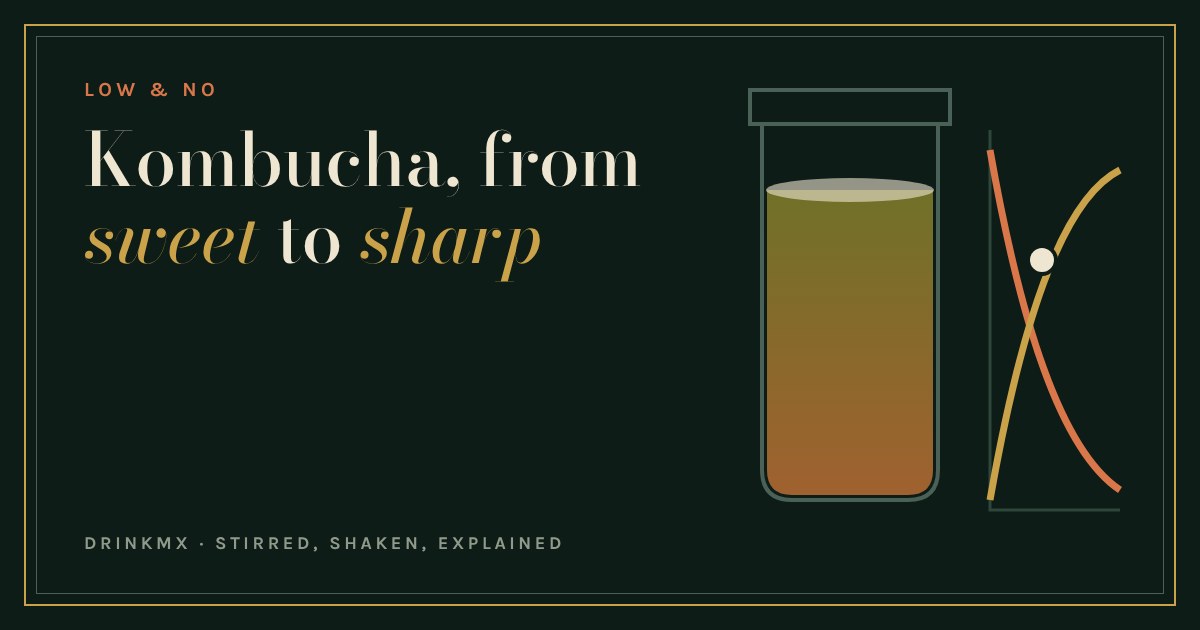
Kombucha starts as sweet tea and ends, if you forget about it, as something close to vinegar. The change is not random. A living culture eats the sugar, makes acid, and the clock it runs on is mostly time and temperature. Once you see that, "how long should I leave it?" has a real answer: until it tastes the way you like.
What is actually happening
Kombucha is sweetened black or green tea plus a starter: a spoonful of finished kombucha and a SCOBY (a rubbery disc of bacteria and yeast, short for "symbiotic culture of bacteria and yeast"). The yeast breaks sugar down first, making a little alcohol and carbon dioxide. The bacteria then turn that into acids, mainly acetic acid, the same one in vinegar. As the sugar falls and the acid rises, the drink swings from sweet to tart.
That acid is also a safety feature. Public food-safety guidance for home brewers asks for a starter that is already acidic (pH 4.0 or lower in one university extension guide, below 4.5 in another) so the batch is sour from day one and unfriendly to anything you don't want. Use a good chunk of finished kombucha from your last batch, not a splash.
Drag the clock
Pick a room temperature, then drag the marker along the days. The model is a rough rule of thumb, not lab data: warmer jars run faster, cooler ones slower, and every culture is a little different. Your own tongue is the final test.
Why the temperature matters
Home-brew guidance from US university extension services puts the first fermentation at roughly 20 to 25 °C (68 to 77 °F) in one guide and a warmer 24 to 29 °C (75 to 85 °F) in another, over about 7 to 10 days. The gap is the point: a cooler kitchen takes longer and tastes gentler, a warm one rushes ahead and can overshoot while you are at work. Keep the jar out of direct sun and away from draughts.
Taste from day five. The recipe's number of days is a guess; your jar's flavour is the fact.
To taste, slide a clean straw or spoon down past the SCOBY and take a small sip. Stop when it is tart enough that you would want to dilute it a little, then bottle it or move it to the fridge. Cold slows the culture right down.
A word on alcohol and bottling
Kombucha always contains a trace of alcohol, because yeast makes it on the way to acid. A university extension guide says a correctly made batch should stay very low, under about 0.016%, but that longer fermentation means more alcohol. Bottling it for a fizzy "second fermentation" with fruit or juice adds fresh sugar for the yeast, so alcohol and pressure can both climb. Regulators note that a bottle that started below 0.5% can pass it if fermentation carries on, so treat home batches as not guaranteed alcohol-free.
Practical rules: leave generous headspace, use bottles built for fizz, open them over a sink, and put them in the fridge once they are lively. Food-safety guidance also says kombucha is not suited to everyone: children, pregnant women and people with weakened immune systems are told to avoid it or ask a doctor first. It also carries a little caffeine from the tea. If you want an alcohol-free fizzy drink with no doubt, our soda-water and shrub pieces are the safer route.
What to look for
- A strong starter. Use finished kombucha from a healthy batch, a good proportion of the new jar, so the acid is there from day one.
- Clean everything. Wash jars with hot water, rinse well, and skip soap residue. Throw the batch away if you see fuzzy mould on top (not the stringy brown bits, which are normal yeast).
- A steady, warm-ish corner. Consistent temperature gives consistent results.
- Your tongue as the clock. Start tasting early and write down the day you liked best.