Bargain€59
Pierre Blender BL5000
A simple glass-jug blender that covers the basics: enough power to whip a small amount of juice pale, and a jug that goes in the dishwasher.
1200 W · 1.5 l glass jug · Dial speed control
A Garibaldi is only Campari and orange juice, but the juice is what makes it. Blend it until pale and foamy and it floats on the red bitter as a soft cloud instead of muddling in.
The classic spec is 45 ml Campari to 120 ml fresh juice. Build your own with sliders, flip between flat and fluffy juice, and see the ratio, strength and balance, plus a no-alcohol swap and what to look for in a blender.
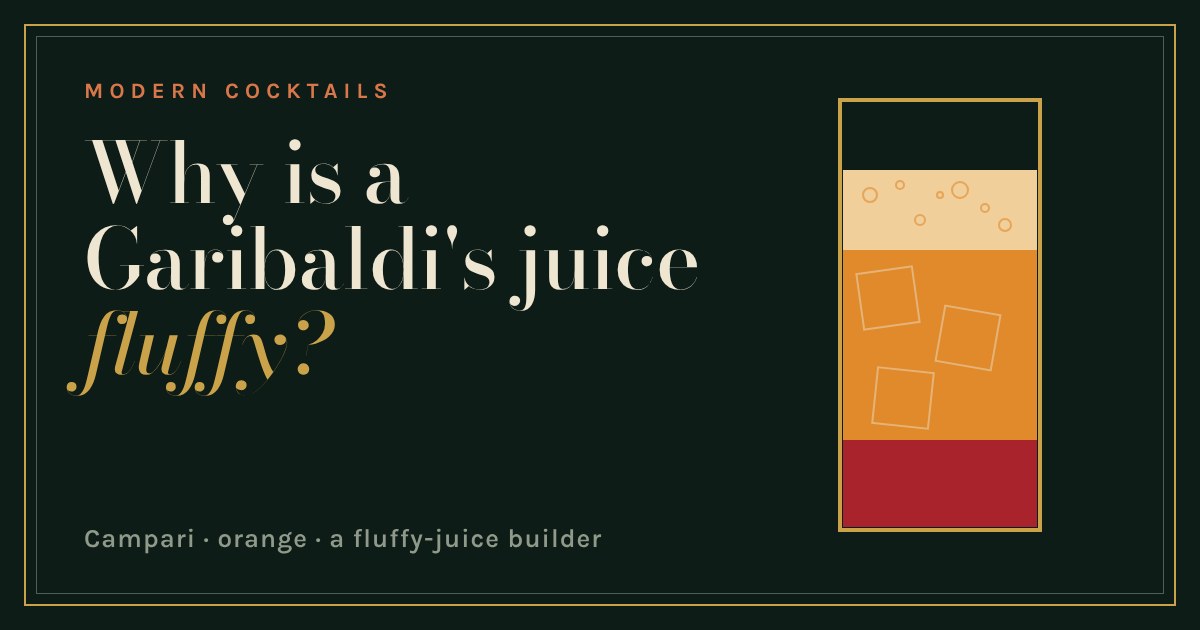
A Garibaldi is two ingredients: Campari and orange juice, over ice. It is also the drink that taught bartenders to care about how they treat the juice. Pour the same juice flat and you get a bitter orange drink. Blitz it first and you get a pale, airy cloud that sits on the red Campari, softens the bitterness and looks like nothing else on the menu. The recipe did not change. The texture did.
Method: squeeze the orange and strain out the pulp. Blend the juice on high for about 10 seconds without ice until it is pale and foamy, or use the bar trick below. Pour the Campari into a small highball over a couple of ice cubes, add more ice, then top with the fluffy juice. Glass: small highball. Garnish: an orange wedge on the rim. Serve at once, because the foam does not wait around.
The Garibaldi is an Italian aperitivo named after Giuseppe Garibaldi, the nineteenth-century general of Italian unification. The usual story is that the drink is a map: Campari from Milan stands for the north and the red shirts of Garibaldi's volunteers, and Sicilian oranges stand for the south. It became popular around 1960, and the IBA list has included it on and off since 1986. Its second life began when Naren Young put it on the menu for the 2015 relaunch of Dante in New York, where it became a signature serve. Dante's fluffy-juice version made the style famous. Stories about who first foamed the juice vary, so treat any single name with caution.
Campari is bitter, sweet and about 25% alcohol. Orange juice is sweet, sour and watery. In a plain build the two simply mix, and the first sip is mostly juice and the last is mostly bitter, because the denser Campari tends to sink. Whipping the juice changes three things.
Same Campari, same juice, different texture.
At home the usual trick is to squeeze the juice by hand, then run it in a blender for a few seconds, sometimes with one or two ice cubes, until it turns pale and lofty. A hand blender in a tall jug can work too, though the result is usually less thick.
As with any drink, go slowly: this one is easy to drink and about as strong as a small glass of wine.
You do not need a bar-grade juicer to get the cloud. What matters at any budget is how well the blender can whip a small amount of juice, and how easy it is to clean.
Affiliate links, marked sponsored. We may earn a commission at no extra cost to you. Kit for this drink at three prices. Prices checked 31 Oct; every shop is on each product page.
A simple glass-jug blender that covers the basics: enough power to whip a small amount of juice pale, and a jug that goes in the dishwasher.
1200 W · 1.5 l glass jug · Dial speed control
More power and finer control, so you can stop the moment the juice turns pale and foamy for a Garibaldi-style cloud.
1500 W · 2 l glass jug · 6 settings
A heavier, more fully featured machine with pulse and eight speed settings, handy for small batches that need fine control and for crushed ice.
1300 W · Borosilicate glass jug · Pulse and 8 speeds