Everyone knows a capsule costs more than a spoonful of beans. What is harder to see is when the dearer cup still makes sense, and when a cheap machine and a bag of beans pay for themselves. Start with one number: what one cup costs you to make. Then add what the machine costs, and spread it over the cups you really drink.
The cost of one cup
For beans or ground coffee the sum is short: the dose in grams times the price per gram. A bag at €20 a kilo is 2 cents a gram, so a 9 g espresso dose is about 18 cents of coffee. A filter mug of 250 ml at the usual 60 g per litre needs about 15 g, which is 30 cents at the same price. The common brewing guide from the Specialty Coffee Association sits near 55 g per litre, and most home brewers land between 55 and 65.
For a capsule, the price is printed on the box. Divide the box price by the number of capsules. Nespresso says its Original line holds about 5 to 5.8 g of coffee per capsule and its Vertuo line 7 to 12 g, so a capsule is not a bigger dose, you are paying for the convenience, the packaging and the sealed freshness. Many shops sell compatible capsules too, at different prices, so use your own number.
The machine is a one-off cost. The coffee is the cost you pay every morning.
Try it with your own numbers
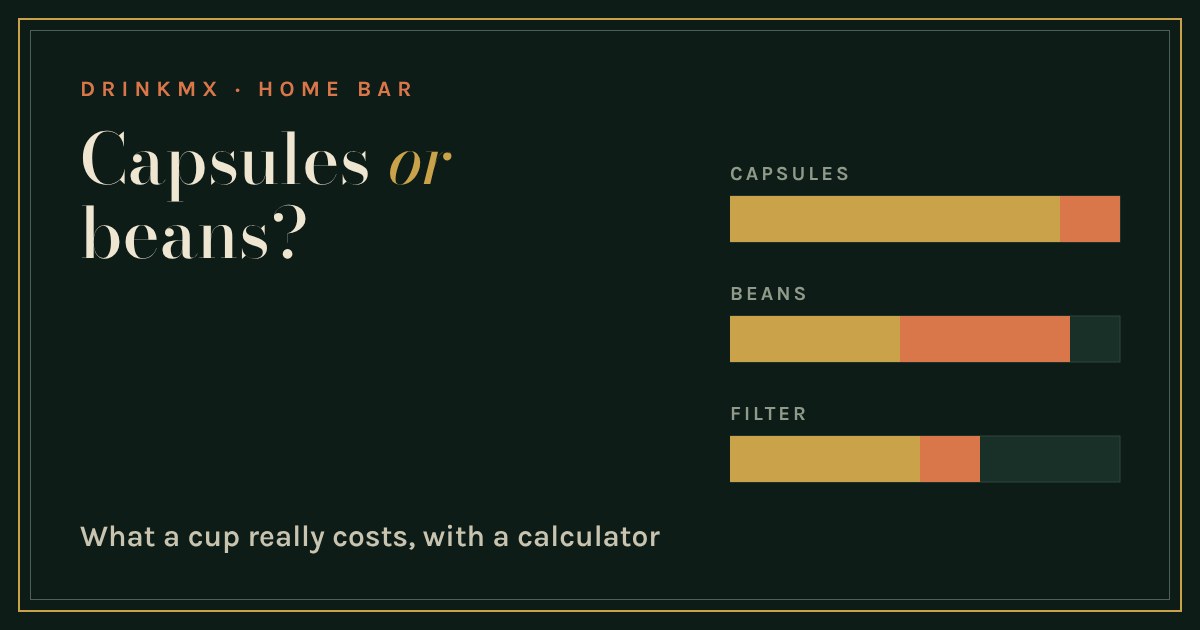
Set how many cups you make a day, then the price of a capsule and of a kilo of beans. The bars show what each route costs over three years, machine included. The defaults are examples, not shop prices: change every one of them.
What the numbers show
Three things usually come out of this. First, the coffee, not the machine, is most of the bill once you drink two or more cups a day. A cheap capsule machine can cost the least in the first month and the most by the end of the first year. Second, the bean machine costs more up front but the gap closes faster the more you drink. Third, a filter mug uses more coffee than an espresso, so it costs more per cup than espresso from the same bag, but one pot serves several people and the machine is cheap.
When should you break the rule? If you make one cup a week, the machine price decides everything and the cheap capsule machine wins. If you want a different taste every day, or a single cup with no waste, capsules earn their price. And if the beans go stale before you use them, the per-gram price is a lie: the cup that gets thrown away is the dearest one.
Hidden costs to add yourself
The calculator leaves out milk, descaling tablets, water filters, a grinder if your machine has none, and the time you spend cleaning. A semi-automatic espresso machine that takes ground coffee usually needs a separate grinder, so add that to the machine price. A bean-to-cup machine grinds inside, which is why it costs more, and it needs its brew unit rinsed and descaled as the maker says.
On caffeine: the European Food Safety Authority says up to 400 mg a day is safe for most healthy adults, and a single espresso holds roughly 60 to 80 mg, so four to six cups a day is already near that line. The slider stops at six cups for that reason, and it is also a reasonable ceiling for most days.
What to look for
Whatever the budget, four things matter. Check what each cup really costs, including capsules, before you compare machines. Pick the route you will use every day, not the one that looks best on the shelf. For beans, a built-in grinder or a separate burr grinder matters more than extra pressure figures. And look at upkeep: how easy the water tank, drip tray and brew parts are to clean and descale, because a machine that is a chore ends up unused.