Ale or lager? Why the yeast and the thermometer decide, with a fermentation slider
Ale and lager are not about colour or strength. They are two families of yeast, and the temperature each one ferments at shapes the beer.
Slide a thermometer from cold to warm to see where lager yeast and ale yeast are comfortable, and what you are likely to taste: clean and crisp, tidy and malty, or fruity and spicy.
We also cover the exceptions, like Kölsch, altbier and California common, and how to choose between them.
Walk up to a bar and the tap handles mostly fall into two families: ales and lagers. The names sound like they describe flavour, but they describe something earlier: which yeast made the beer, and how warm it was kept while it worked. Once you know that, the rest of the label starts to make sense.
One word, two yeasts
Yeast is the living thing that eats sugar and makes alcohol and carbon dioxide. Brewers use two main families. Ale yeast (Saccharomyces cerevisiae) is called top-fermenting because it tends to gather near the surface. Lager yeast (Saccharomyces pastorianus) is called bottom-fermenting and is a hybrid of ale yeast and a cold-tolerant relative. It settles low, and it keeps working at temperatures that would slow an ale yeast right down.
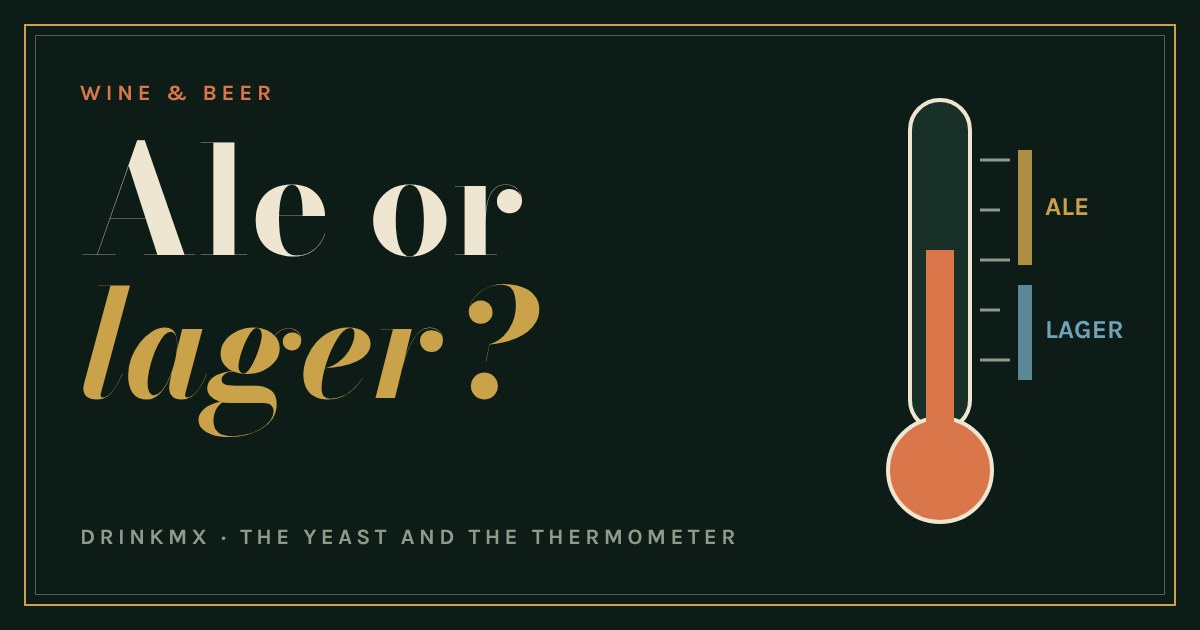
The common ranges, from homebrewing guidance, are roughly 16–26 °C (60–78 °F) for ales and 9–14 °C (48–58 °F) for lagers. They are rules of thumb, not walls, and every strain has its own sweet spot.
Slide the thermometer
Drag the slider to set a fermentation temperature and see which yeast is comfortable there, and what the beer is likely to taste like.
What the temperature does
Yeast does more than make alcohol. It also produces small flavour compounds, and warmth turns that production up. Esters smell fruity (banana, pear, apple). Phenols smell spicy or clove-like. A warm ale fermentation lets both through, which is why many Belgian and wheat beers taste so aromatic. A cool lager fermentation keeps them quiet, and what is left tastes of malt, hops and clean bitterness.
The second difference is time. Lagers are usually cold-aged, or lagered, for at least two to three weeks near 0 °C (32 °F). Yeast and haze-forming proteins settle out, and the beer finishes smooth and bright.
Ale versus lager is a question about the yeast and the thermometer, not about colour or strength.
Colour and strength don’t decide it
A dark beer can be a lager (a schwarzbier is) and a pale beer can be an ale (a Kölsch is). A strong beer can be either. If you want to know which family a beer belongs to, look at the name of the style and ask how it was fermented.
The exceptions worth knowing
Kölsch and altbier from Germany use ale yeast at cool, lager-like temperatures, then are conditioned cold. They drink like lagers, with a hint of fruit. California common (steam beer) goes the other way, using a lager strain at warmer, ale-like temperatures. Rules of thumb are useful, and these styles show where they bend.
Which one should you pour?
Reach for a lager when you want something crisp, clean and refreshing, with food or on a hot day. Reach for an ale when you want more aroma and character: fruit, spice, roast or a hop-forward bite. Pour both into a clean glass, serve them cool rather than ice-cold, and give the aromas a moment, as most of what you taste you smell first.
As always, enjoy beer in moderation. If you would like the taste with no alcohol, many breweries now make alcohol-free lagers and ales, and the same yeast story applies to them.