Why a Manhattan is two parts whiskey to one of vermouth, with a ratio and stir-time builder
The Manhattan is whiskey, sweet vermouth and bitters, stirred and served up. This page gives the IBA spec and the common bar version in ml and oz, then lets you move the whiskey-to-vermouth ratio and the stir time to see how strength and meltwater change in the glass.
It explains why the drink is stirred rather than shaken, why rye is traditional, how to keep vermouth fresh, what the history really says, and how to make lower-strength and alcohol-free versions. Please drink responsibly.
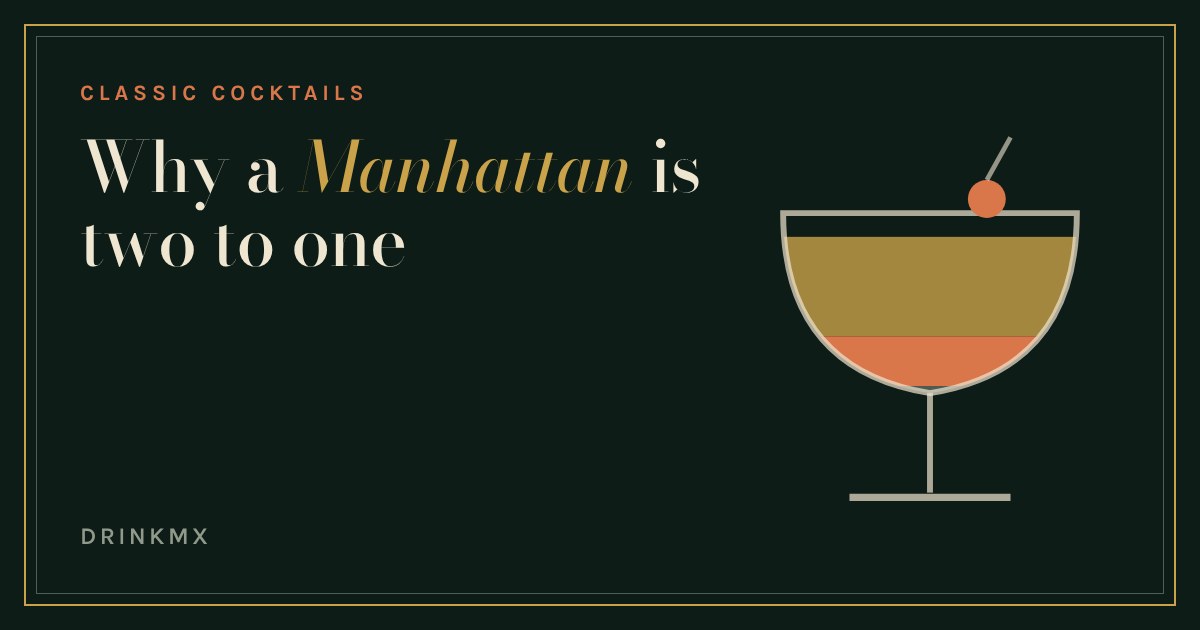
A Manhattan is whiskey, sweet vermouth and bitters, stirred cold and served up. It looks like the easiest drink in the book, and it is, until the vermouth is the wrong amount. Too little and it tastes like hot, sharp whiskey; too much and it turns syrupy and red. The whole drink lives in one ratio, so the calculator below lets you move it and see what happens to the strength and the glass.
The spec, and how to make it
The IBA (the International Bartenders Association) lists 50 ml rye whiskey, 20 ml sweet red vermouth and 1 dash of Angostura bitters, stirred with ice, strained into a chilled cocktail glass and garnished with a cocktail cherry. That is about 2.5 parts whiskey to 1 part vermouth. Many bars pour a straight 2:1, such as 60 ml whiskey to 30 ml vermouth with 2 dashes of bitters, which is where the calculator starts. Both are fine; specs differ between books, and you can tune the ratio to your bottles.
- Put a coupe in the freezer, or fill it with ice and water while you work.
- Fill a mixing glass with plenty of ice, then add the whiskey, vermouth and bitters.
- Stir for about 20 to 30 seconds, until the outside of the glass is frosty and the drink is very cold.
- Tip out the ice water from the coupe and strain the drink in.
- Add a cherry. If you use an orange twist, squeeze it over the top first so the oils land on the surface.
Why it works
Whiskey on its own is strong and a little hot. Sweet vermouth is a wine that has been fortified (strengthened with spirit) and flavoured with herbs, so it brings sweetness, a gentle bitterness and spice. The bitters tie them together, a bit like salt in cooking. Rye whiskey is peppery and dry, which is why it is the traditional choice: it stands up to the sweet vermouth. Bourbon is softer and sweeter and makes a rounder drink; neither is wrong.
It is stirred, not shaken, because there is no juice or egg to blend. Stirring chills and dilutes the drink gently and keeps it clear and silky, while shaking makes it frothy and cloudy. The meltwater matters: it takes the edge off the alcohol and lets the flavours open up. Try the stir-time slider above. A short stir leaves a hot, sharp drink, and a very long one makes it thin.
Two parts whiskey, one part vermouth, and a little water from the ice.
Bend the ratio, carefully
Vermouth is the part most people get wrong. Open bottles go stale, because it is wine: keep it in the fridge with the cap on and use it within a few weeks. A flat, brown-tasting vermouth makes a flat Manhattan. If your drink tastes too sweet, move towards 3:1 before you change the whiskey. If it tastes too sharp, add a little more vermouth or stir a few seconds longer. Change one thing at a time, and write down what you did.
A short, honest history
The popular story says the drink was invented in the 1870s at the Manhattan Club in New York for a banquet hosted by Jennie Jerome, later Lady Randolph Churchill. Cocktail historians treat that as unlikely, since she was in France at the time. What is certain is that recipes were in print by the 1880s: two 1884 bartenders' guides, one by Charlie Paul and one by O.H. Byron, list versions. An 1891 book, William Schmidt's The Flowing Bowl, gives roughly 2:1. Beyond that, the exact inventor is not known.
Variations, including a lighter one
- Perfect Manhattan: equal parts sweet and dry vermouth. Drier and lighter, with an orange or lemon twist.
- Dry Manhattan: dry vermouth in place of sweet, usually with a twist.
- Rob Roy: the same build with Scotch whisky.
- Black Manhattan: an Italian amaro (a bittersweet herbal liqueur), such as Averna, instead of vermouth, with a dash of orange bitters.
- Lower strength: use 30 ml whiskey, 30 ml vermouth and 2 dashes of bitters. You get a drink at roughly 25% alcohol that tastes like a Manhattan, only softer.
- Alcohol-free: an alcohol-free spirit made to taste like whiskey, a splash of alcohol-free red vermouth-style aperitif, and bitters. Bitters contain alcohol in tiny amounts, so check if you need to avoid it entirely. It will not taste the same, but the bitter-sweet shape holds.
Whichever version you pick, drink it slowly. A Manhattan is a strong drink, roughly 28 to 30% alcohol at the common 2:1 spec, and the sweetness hides that.