Why a Tom Collins is a gin sour made long: the spec and a soda and strength builder
A Tom Collins is a gin sour made long: gin, lemon and syrup shaken, strained over fresh ice and topped with soda. The spec is 50 ml gin, 25 ml lemon and 15 ml rich syrup.
Use the builder to see what the soda does: it makes the drink taller and milder but removes none of the alcohol. Switch to Old Tom (sweeter, so less syrup) or a 0.0% spirit, and see the history, including the 1874 hoax behind the name.
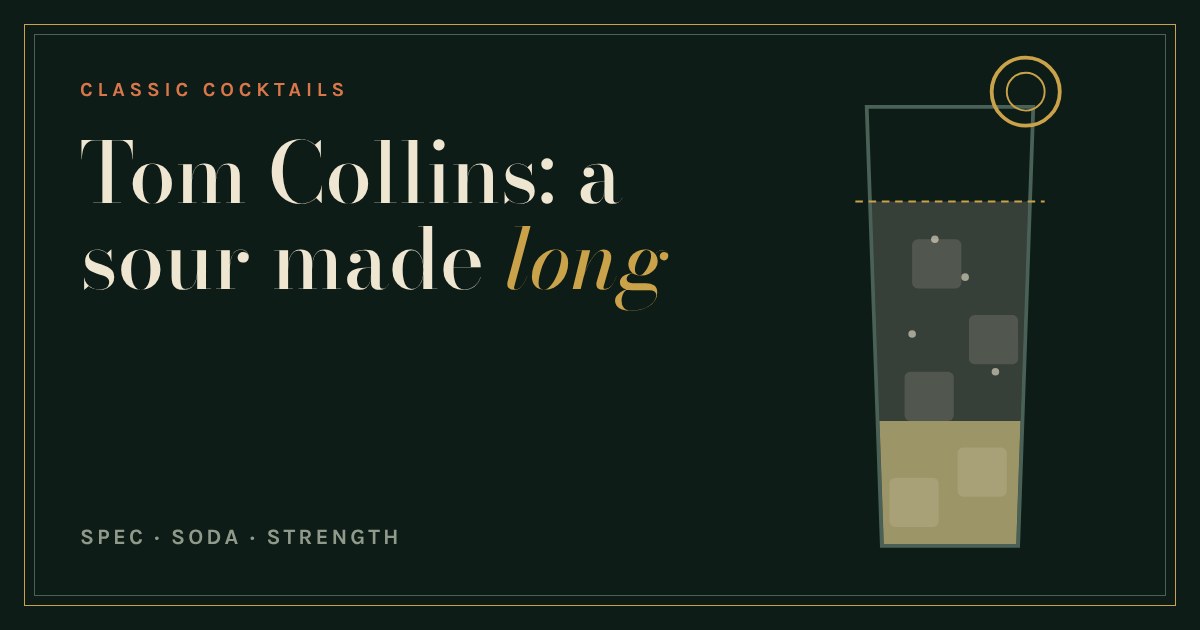
A Tom Collins looks like a long, pale lemonade, and that is exactly what it is: a gin sour that has been stretched with soda water. Once you see it as a short drink made long, the whole recipe makes sense, and so does every question people ask about it: how much soda, which gin, why it is shaken and then topped.
The spec
Method: shake the gin, lemon and syrup hard with ice, strain into a tall glass filled with fresh ice, top with soda and give it one gentle stir. Glass: a Collins glass, which is simply a tall, narrow tumbler of about 300–400 ml, ideally chilled first. Garnish: a lemon or orange wheel and, if you like the old look, a maraschino cherry.
Why it is shaken, then topped
The gin, lemon and syrup are the sour, the same family as a Daiquiri or a Sidecar. Citrus juice is cloudy and sugar is dense, so they need a proper shake to blend and chill. Shaking also adds water: roughly a fifth of the volume melts into the drink, which softens the lemon and rounds the gin.
Soda is different. It is already cold, already clear and its job is bubbles, so you add it last and stir only once. Stir hard and you knock out the fizz you have just paid for. Pour the soda down the side of the glass or over the back of a spoon if you want the bubbles to last.
Use fresh ice in the serving glass, not the ice from the shaker. Shaker ice is already broken and wet, so it melts quickly and leaves the last third of the drink watery. A tall glass packed with big, dry cubes stays cold and stays fizzy for the length of a long drink.
Strength: a gin sour in disguise
A Tom Collins feels light because it is tall and cold, but the gin is the same amount as in a Martini. That is why the soda matters for more than taste: every extra 30 ml of soda lowers the strength, but does not remove any alcohol. Use the builder to see the numbers for your own glass.
Why the soda is not a fixed number
Recipes say 50 or 60 ml of soda, but that is really a way of filling the glass. A 300 ml glass wants less than a 400 ml one, and the right amount is the point where the lemon and gin still taste like themselves. A good rule of thumb: the topped drink should be about one part sour to one part soda by volume, so around 60 ml of soda on the shaken base. Past 100 ml you have a gin and lemon soda, which is fine, but it is a different drink: lighter, milder and easier to drink quickly.
Break the rule when your lemons are very sharp or your ice is slow to melt: a little more soda is then kinder. Break it the other way when you are serving in the sun, since ice melts fast outdoors and a drink that tastes right at the first sip is thin by the last.
A Collins is a sour that has been given somewhere to go.
Tom, John and a name with a hoax in it
The history is tangled, and it is worth saying where the sources disagree. A drink called the John Collins existed by the 1860s, and the name is often linked to a headwaiter of that name at Limmer's Hotel in London, though that origin is not proven. A recipe from 1869 calling for Old Tom gin, a lightly sweetened style, is sometimes cited as the reason the name changed to “Tom”, though one major drinks guide questions that claim.
In 1874 a prank spread through New York and Pennsylvania: people asked “Have you seen Tom Collins?” and newspapers ran made-up sightings, which helped the name stick. Jerry Thomas's bar guide includes a Tom Collins in its later editions, and Harry Johnson's 1882 manual gives a Tom Collins with Old Tom gin and a John Collins with Holland gin (genever). Many modern writers use the shorthand that Tom means Old Tom and John means dry gin or whiskey, but through most of history the names were used interchangeably.
Variations, including a low and no one
London dry vs Old Tom. London dry gives the crisp, bone-dry version most bars serve today. Old Tom is the sweeter style the drink was named for; cut the syrup to about half, as the builder does.
Alcohol-free Collins. Swap the gin for 50 ml of a 0.0% juniper spirit, keep the lemon and syrup, and top with soda. Non-alcoholic spirits are often lighter in body, so shake with ice but taste before adding all the soda. The builder's 0.0% option shows the same volumes at zero strength.
Lower-strength Collins. Use 35 ml of gin and top with 90 ml of soda for a longer, gentler glass, and keep the lemon and syrup the same. Alcohol content in a mixed drink is easy to underestimate, so measure rather than pour freely, and pace yourself with a glass of water.
Other collins. The same shape works with other spirits: whiskey, vodka, rum or tequila with lemon or lime, syrup and soda. Add a little fruit or a herb and you have a simple house drink for a party.
What to look for
The Collins needs little kit, and most of it is cheap. Look for a tall glass that holds at least 300 ml with room for ice; a shaker with a tight seal that you can hold in one hand; fresh lemons, since bottled juice is flatter and often sweeter; and a soda that is cold and freshly opened, because flat soda cannot be fixed with extra stirring. A proper measure, either a jigger or a small cup marked in ml, matters more than any brand of gin.